
Descripton
FAR: Lone Sails is one of those games that is genuinely difficult to slot into a single genre — and I think that is part of why it is so memorable. It is not quite a platformer (and some will argue it doesn’t has its place here!), not quite a puzzle game, not quite a walking simulator. What it is, more than anything, is a journey. You are a tiny figure in a vast, dried-out world, keeping an enormous steam-powered land vehicle moving through the ruins of a civilisation that no longer exists. There is no combat, no dialogue, no score. Just the wind, the creak of machinery, and an horizon that never stops pulling you forward.
The atmosphere and spirit of this game place it firmly in the cinematic platformer tradition — the isolation, the environmental storytelling, the deliberate pace — even if its mechanics sit slightly outside it. If you love this genre, FAR: Lone Sails belongs in your collection.

Year: 2018
Developer: Okomotive Atmosphere: Lonely · Post-Apocalyptic · Melancholic
Visual Style: Painterly 2.5D · Minimalist
Focus / Pace: Exploration · Relaxed
Platforms: Windows · macOS · PlayStation 4 · Xbox One · Nintendo Switch · iOS · Android
Why FAR: Lone Sails stands out
FAR: Lone Sails began in 2015 as Don Schmocker’s bachelor’s thesis at the Zurich University of Arts in Switzerland. The prototype gathered enough attention and awards that Schmocker kept building — and while still enrolled in his master’s program, he assembled a small team of fellow students, partnered with publisher Mixtvision, and founded studio Okomotive in 2017. The game was invited to the E3 ID@Xbox showcase in 2016 before it was even finished, and by the time it launched on PC in May 2018, it arrived to overwhelmingly positive reviews.
What makes that origin story so fitting is how much the game feels like a personal vision rather than a product. Every design decision — the wordless storytelling, the relationship between player and vehicle, the carefully timed environmental reveals — traces back to Schmocker’s core idea of capturing the feeling of a long train journey, watching an unfamiliar world roll by outside the window. That specific, quiet feeling is what the whole game is built around, and it comes through in every frame.
The Story
FAR: Lone Sails tells its story almost entirely without words. You begin standing beside what appears to be a grave — most likely your father’s — before climbing into the enormous vehicle he left behind and setting off across a vast dried seabed. Posters and signs along the route hint at a mass exodus — a civilisation that fled a dying world in search of something called the Blue Isles, a promised fresh start somewhere beyond the horizon.
That is roughly all the plot you get, and it is exactly the right amount. The story lives in the world itself: in the ruins of houses half-buried in sediment, in the abandoned machinery of a people on the move, in the scale of everything around your tiny protagonist. By the time the ending arrives — and it is a genuinely beautiful ending — you have pieced together enough to feel the weight of it without ever having been told a single thing outright. It is environmental storytelling at its most economical and most effective.
Graphics
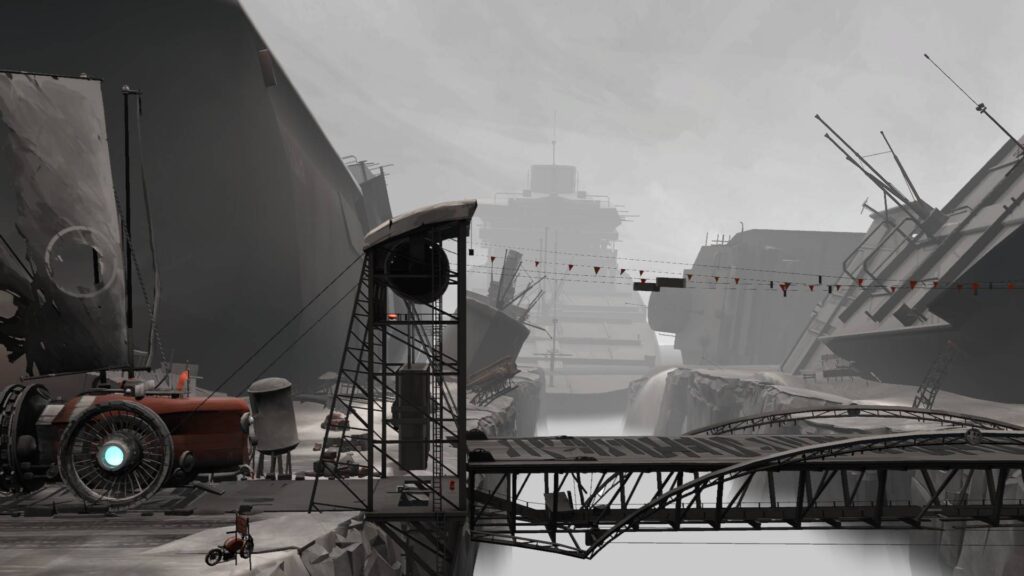
FAR: Lone Sails has a visual style that I find genuinely hard to shake once you have seen it. The world is rendered in painterly 2.5D — soft, muted skies layered over a bleached landscape littered with the wreckage of a lost civilisation. It looks like a watercolour left out in the sun too long, and that slight fading quality feels entirely intentional. This is a world that has been emptied out, and the art direction makes you feel that in your bones.
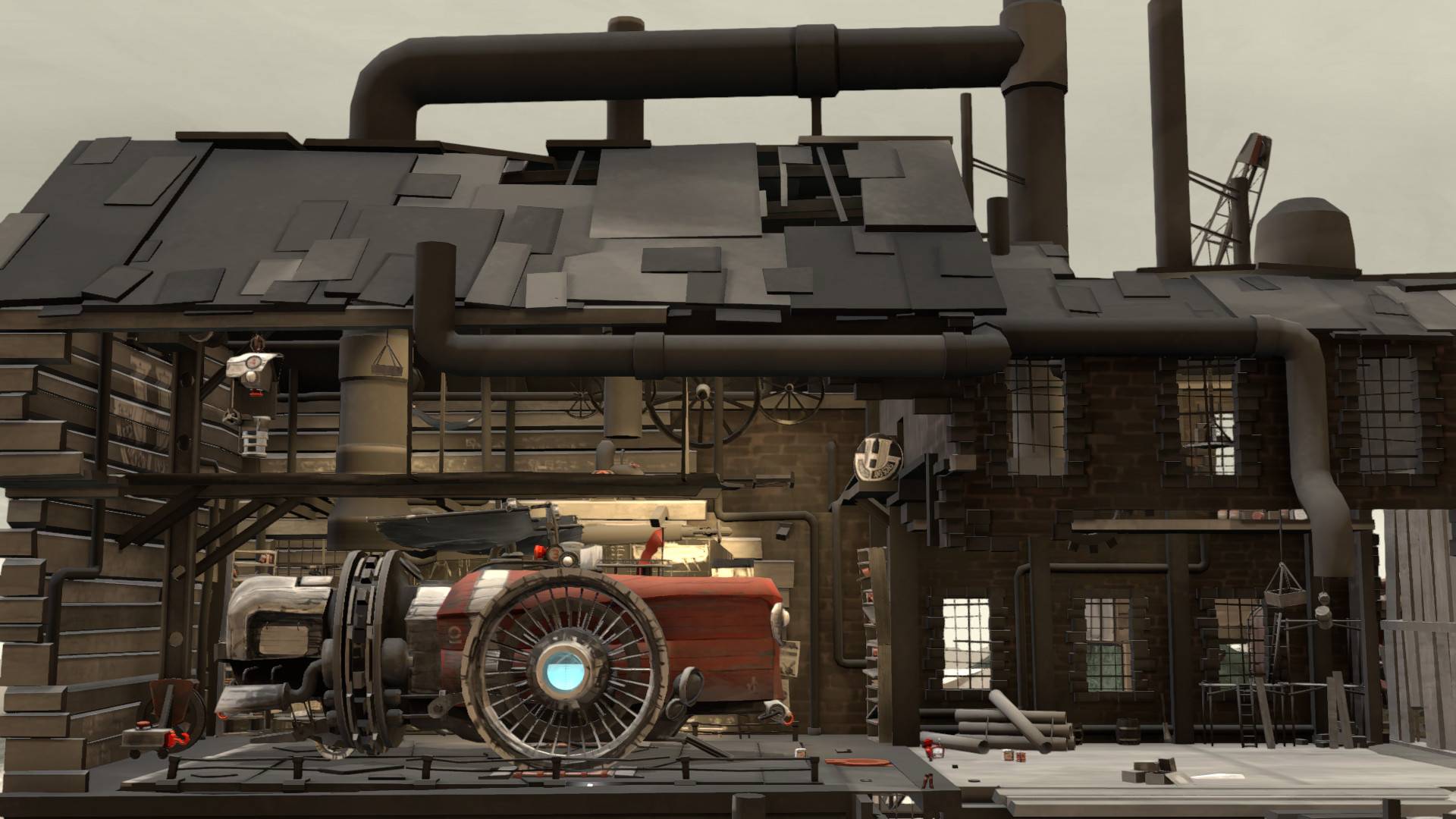
The cross-section view of the vehicle interior is a masterstroke. As you manage the engine from inside while the ruined world scrolls past the portholes behind you, the game creates a constant tension between the intimate and the vast that very few games manage. You are simultaneously inside a small mechanical space and moving through an enormous, desolate landscape — and both feel equally real.
🏆 Did You Know?
Despite designing a game entirely built around driving a massive land vehicle across a post-apocalyptic world, Don Schmocker doesn’t actually have a driving licence. The original inspiration for FAR came from train journeys he took across Germany as a student — he wanted to recreate that feeling of sitting back and watching an unknown world pass by, without any need to hurry.
Gameplay
FAR: Lone Sails is built around one central relationship: you and your vehicle. The Okomotive — as the studio is named after it — is a lumbering, steam-powered land boat that you must fuel, maintain and repair as you cross the dried seabed. You run back and forth inside it, feeding the boiler with scraps of fuel found along the route, releasing pressure before it overheats, deploying sails when the wind picks up, and jumping out to clear obstacles or solve the occasional environmental puzzle.
What makes this work so well is that the vehicle genuinely feels alive. You learn its rhythms. You develop a routine. And when something goes wrong — a fire breaking out mid-storm, the engine sputtering on the last scraps of fuel — the low-stakes tension is surprisingly gripping for a game with no combat whatsoever. I found myself genuinely attached to the thing in a way I did not expect.
The puzzles scattered along the route are simple but well-judged, introducing new mechanics — a crane here, a wind turbine there — without ever overcomplicating what is fundamentally a meditative experience. This is not a game that wants to challenge you. It wants to move you.
Pacing
FAR: Lone Sails runs around three hours, and that length feels precisely right. The game never rushes you and never lets things stagnate — just as a stretch of open, quiet traversal starts to feel almost too peaceful, something arrives on the horizon to pull your attention forward. A collapsed city. A violent storm. A discovery that reframes everything around it. Schmocker’s background in designing carefully timed environmental reveals pays off constantly here.
My one honest note is that the very early section — before the vehicle is fully operational — moves a touch slowly even by the game’s own standards. But it is brief, and once the Okomotive finds its rhythm, so does everything else.
Atmosphere
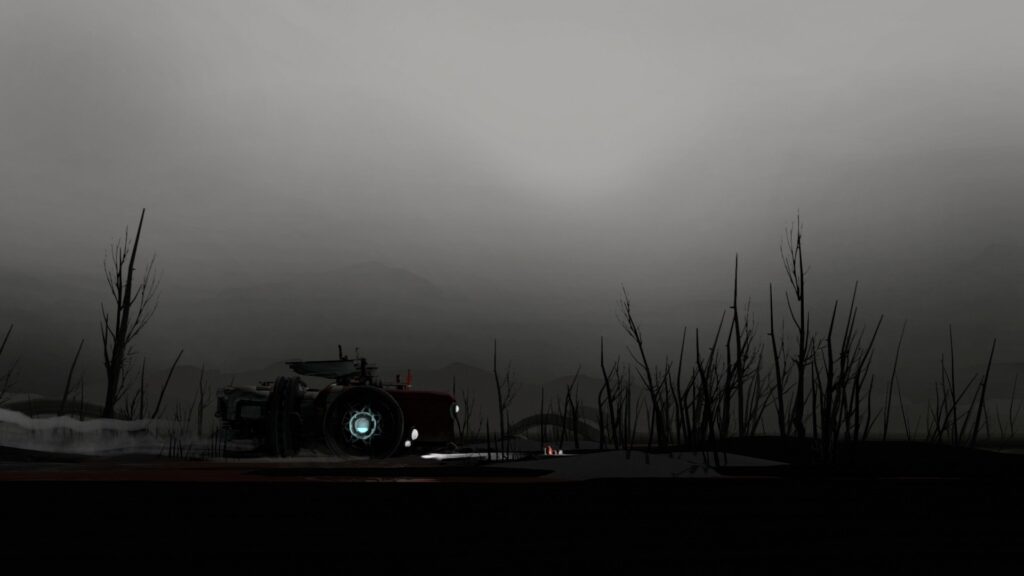
This is where FAR: Lone Sails lives or dies, and it absolutely lives. The atmosphere is melancholic in a way that feels earned rather than imposed — quiet and vast and tinged with a sadness that never tips into misery. The world feels genuinely post-human, not in a violent apocalypse way but in the way of something simply… over. People were here. They left. You are following, very late, across what they left behind.
Joel Schoch’s soundtrack deserves a lot of credit for this. It is sparse and unhurried — piano, ambient textures, the occasional swell that arrives at exactly the right moment. Combined with the sound design of the vehicle itself — the hiss of steam, the creak of metal, the drum of rain on the hull — it creates a sensory world that feels fully inhabited despite being almost entirely empty.
🎮 My honest opinion on FAR: Lone Sails
FAR: Lone Sails is the kind of game I think about when someone asks me what games can do that other mediums cannot. It is not the story — the story is barely there. It is not the mechanics — they are simple almost to a fault. It is the specific feeling of being alone in something enormous, moving through a world that has already ended, with nothing ahead but the next horizon.
That feeling is rare. And Okomotive, a handful of Swiss design students working on what started as a university thesis, bottled it completely. The fact that the whole thing began as a bachelor’s project and ended up as one of the most quietly affecting games of its era still impresses me every time I think about it.
It is short, it is gentle, and it asks almost nothing of you mechanically. For some players that will be too little. But if you meet it on its own terms, FAR: Lone Sails delivers something genuinely difficult to find — a game that feels like a long exhale.
Turning a vehicle into the protagonist is also one of the genre’s most meditative ideas — see why it earned its place among the most inventive cinematic platformers ever made.
Where can I play FAR: Lone Sails?
FAR: Lone Sails is widely available — PC via Steam, PlayStation 4, Xbox One, Nintendo Switch, and iOS and Android. It is modest in price and frequently on sale. A sequel, FAR: Changing Tides, was released in 2022 and moves the setting from the dried seabed to a flooded ocean — a natural companion piece worth playing immediately after.
Similar Games
If FAR: Lone Sails resonated with you, these games share its love of wordless journeys, desolate worlds, and atmosphere that does all the talking.
FAR: Changing Tides (2022)
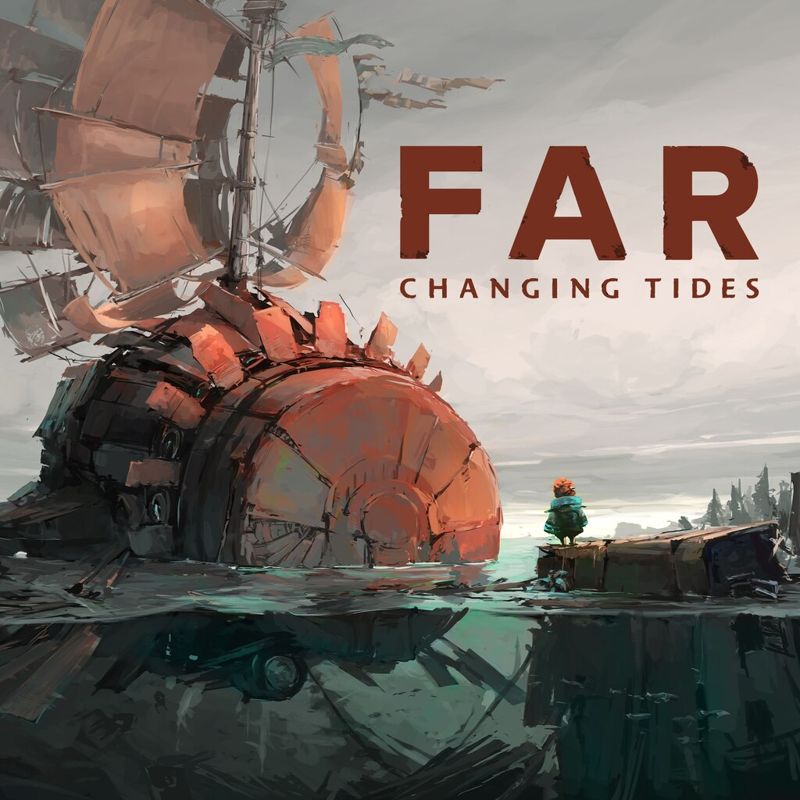
If Lone Sails left you wanting more — and it probably will — Changing Tides is the natural next step. Okomotive took the same core idea and moved it from the dried seabed to a flooded ocean, swapping the land vehicle for a sailing vessel and adding underwater exploration to the mix. The atmosphere is slightly different — wetter, moodier, more dynamic — but the soul is identical. A different world, the same quietly devastating journey. Play them back to back if you can.
Journey (2012)

If FAR: Lone Sails resonated, Journey is its closest spiritual companion — a wordless traversal across a vast, empty world toward a distant horizon, where the relationship between the player and the environment does all the emotional heavy lifting. It remains one of the most purely affecting games ever made, though not really a cinematic platfomer – and thus not featured on our website.
Also, Gris shares FAR’s commitment to wordless emotional storytelling, painterly visual beauty, and a journey structured around atmosphere rather than challenge. Want some other similar games? Click on the button below: