

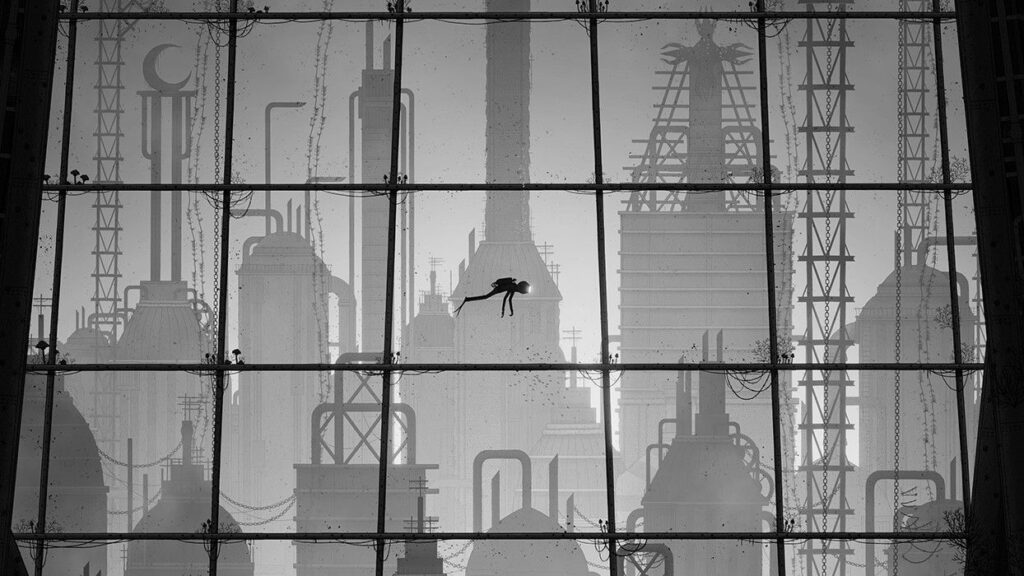
If you have seen that screenshot — a lone diver, tiny and fragile, silhouetted against the enormous open mouth of something ancient and vast — you already understand what Silt is. That image is the whole game. Dark, monochrome, hand-drawn like a nightmare illustrated in a sketchbook, and completely unlike anything else in the genre. I am a sucker for this kind of art style — the ink blots, the frantic penstrokes, the specific texture of something drawn by hand rather than rendered by software — and Silt is one of the best examples of it I have ever seen in a game.
Developed by British studio Spiral Circus — a two-person team, for their debut game — and published by Fireshine Games, Silt released in June 2022. You play as a lone diver who wakes on the seafloor, chained to a weight, in total darkness. The only way to escape is to possess a nearby piranha and use its teeth to bite through the chain. That first moment tells you everything about what Silt is going to be — strange, physical, dark, and built entirely around a mechanic that no other game in the genre uses.

Year: 2022
Developer: Spiral Circus
Atmosphere: Surreal · Oppressive · Ancient
Visual Style: Monochrome · Hand-Drawn Ink
Focus / Pace: Puzzle Platforming · Methodical
Platforms: PlayStation 4 · PlayStation 5 · Xbox One · Xbox Series X/S · Windows · Nintendo Switch
The Story
A diver. An ocean floor. Ancient ruins. Something vast and dark living at the bottom of it all. That is everything Silt tells you directly, and everything it needs to. The story is told entirely through environmental details — the ruins, the creatures, the specific architecture of what you move through — and by the end there is a coherent world with a history and a mythology, none of which has ever been spoken aloud.
My interpretation is that the diver is searching for something ancient and powerful — collecting and sacrificing souls along the way — and that the world below has been waiting for exactly this. Whether that reading is right is something the game deliberately refuses to confirm, and I think that ambiguity is the right choice. Silt is not a game about understanding. It is a game about feeling.
The Possession Mechanic
This is what makes Silt genuinely special, and I want to give it proper space rather than folding it into a general gameplay section. It is also the reason it made in into the list of the most inventive cinematicplatformers.
You are a diver. You cannot fight anything — the ocean at this depth would kill you in seconds if you tried. What you can do is send a tendril of white light out from your mask and possess any creature within range. Each species has a different ability: piranhas bite through ropes, crabs are indestructible and can be used as shields or weights, stingrays can teleport short distances, swordfish move at speed through obstacles. The puzzles are built around combining these abilities — possessing one creature to reach another, chaining possessions together, using one animal to create the conditions for the next.
What I find most satisfying about it is how physical it feels. Possession is not an abstract mechanic — there is a visual and audio feedback to it that makes every transfer feel significant. And the vulnerability of the diver during those moments — body floating inert in the water while your consciousness is elsewhere — creates a specific tension that the game uses brilliantly. You are always aware of what could happen to the body you left behind.

Graphics
I keep coming back to this because I genuinely cannot overstate how striking Silt looks. The monochrome hand-drawn style gives the underwater world a texture that no colour palette could achieve — the darkness feels genuinely dark, the creatures feel genuinely alien, and the occasional moment of stark white light against the black abyss hits with a force that I find almost physical. The creature design is exceptional: each species feels like it belongs to a specific ecosystem, even as that ecosystem becomes increasingly impossible and surreal. The boss creatures in particular are extraordinary — ancient, vast, unlike anything I have seen in the genre.
I found myself stopping to look at the environment more often in Silt than in almost any other game I have reviewed for this site. That is the highest compliment I can give a visual style.
Gameplay
Unforgiving, methodical, and designed around experimentation. Another World does not explain itself — you discover what is possible by trying things, dying, and trying again. The checkpoints are sparse by modern standards. You will die often, sometimes unfairly, occasionally in ways that are almost funny. But the trial-and-error never feels arbitrary — everything has internal logic, and when you find the solution to a puzzle that has been killing you, the satisfaction is absolute.
The combat — a laser pistol that can fire a standard shot, a shield, or a sustained beam — is elegant in its simplicity. Using the shield to reflect an enemy’s blast back at them the first time you realise it is possible is a specific kind of joy. The alien companion sections, where you and your friend must coordinate to overcome obstacles, introduced cooperative gameplay ideas that were years ahead of their time.
🐟 Did You Know?
Silt almost became a completely different game. When Spiral Circus started development, they were imagining something closer to Subnautica — oxygen gauges, crafting systems, survival mechanics. They built all of it, played it, and realised it was getting in the way of the puzzle design. Every time a player had to stop thinking about a puzzle to go collect air, the experience broke.
So they stripped everything out and rebuilt around the possession mechanic alone. The fish in the final game still run complex behaviour simulations — with hunger, predator-prey relationships, and individual movement patterns — but almost none of that is surfaced to the player. It is there entirely to make the world feel alive.
Pacing and Length
At around three to four hours, Silt is exactly the right length. Each chapter introduces a new environment and new creature types, and the escalating complexity of the possession puzzles keeps the game feeling fresh throughout. The difficulty curve has one genuine spike — a late-game chapter that several reviewers found frustrating, and where I spent considerably longer than anywhere else — but it resolves before it becomes a genuine problem.
I played it in two sittings and found the break point natural. The second sitting, knowing the rhythm of the world, felt like returning somewhere I already half-understood.
Atmosphere
The best element, and the one that stays with you longest. Silt has almost no music — the ambient sound design does all the work, and it is extraordinary. The ocean groans and shifts around you. Creatures move through the darkness with sounds that are partly biological and partly mechanical. The silence between sounds is used as deliberately as the sounds themselves.
By the mid-game I was genuinely tense in the quieter sections, which is a remarkable achievement for a game with no jump scares and no conventional horror mechanics. The threat in Silt is not what appears suddenly. It is the weight of everything that is already there, watching.
🎮 My honest opinion
Silt is one of the most distinctive cinematic platformers of recent years — a game that looks unlike anything else, feels unlike anything else, and uses its central mechanic with a creativity and consistency that debut games rarely achieve. The possession system is genuinely inventive, the atmosphere is extraordinary, and the visual identity is the kind that stays in your memory long after you have finished.
It is short and it is occasionally frustrating. It does not explain itself and it does not try to. But if you approach it the way it wants to be approached — slowly, attentively, willing to sit in the darkness for a moment before acting — it delivers something genuinely rare. One of the best debuts in the genre.
Silt made our personal top ten — one of only a handful of modern games we think belongs in the best cinematic platformers of all time.
Where can I play Silt?
Silt is available on PC via Steam, PlayStation 4, PlayStation 5, Xbox One, Xbox Series X/S, and Nintendo Switch. It is modestly priced and completable in a single focused evening.
Games similar to Silt
Limbo
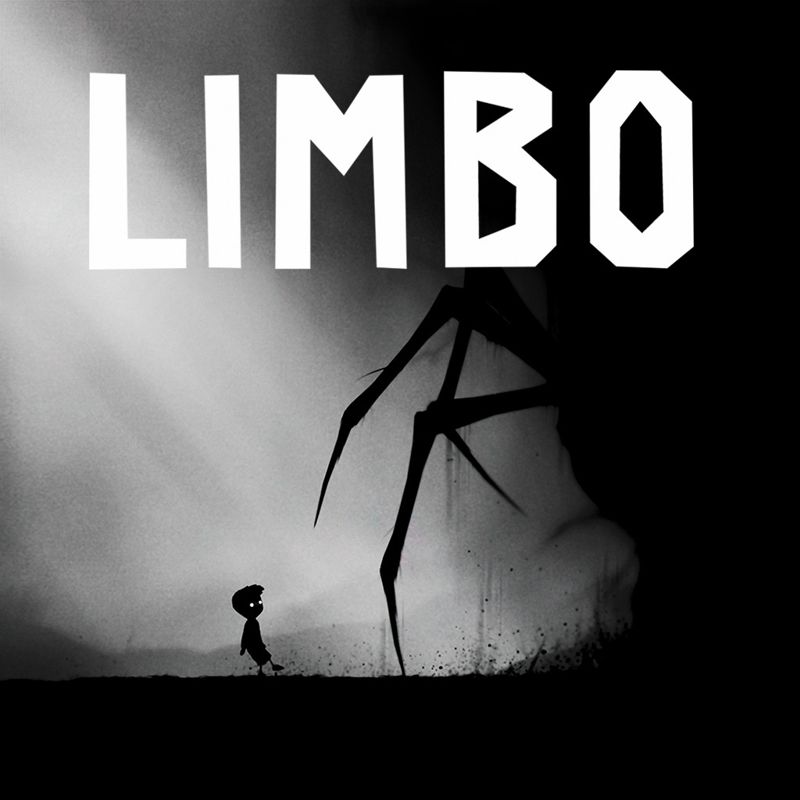
The most obvious visual companion — another monochrome, silhouette-heavy cinematic platformer where a small protagonist navigates an environment that is ancient, hostile, and deeply strange. Limbo is more precisely designed and less atmospheric; Silt is more immersive and more surreal. Both are essential.
The Swapper
The Swapper shares Silt’s instinct for building an entire game around a single innovative mechanic — possession here, cloning there — and the same commitment to letting the environment carry the story rather than explaining it. Both games leave you with more questions than answers, which I think is a feature rather than a flaw.
If you are drawn to cinematic platformers that use their visual identity as a genuine artistic statement — games where the style and the substance are inseparable — Gris, The Mooseman, and Never Alone all share that same commitment to image as meaning.
If the monochrome visual language of Silt is what drew you in specifically — the idea that stripping away colour can add rather than remove — White Shadows and Monochroma both live in that same black and white world.
White Shadows is the more visually ambitious of the two, a high-contrast dystopian platformer that uses light and shadow as deliberately as Silt does. Monochroma is rougher around the edges but shares the same instinct for using a limited palette to create something that feels genuinely oppressive. Neither reaches Silt’s level of atmospheric craft, but both belong on the same shelf.