
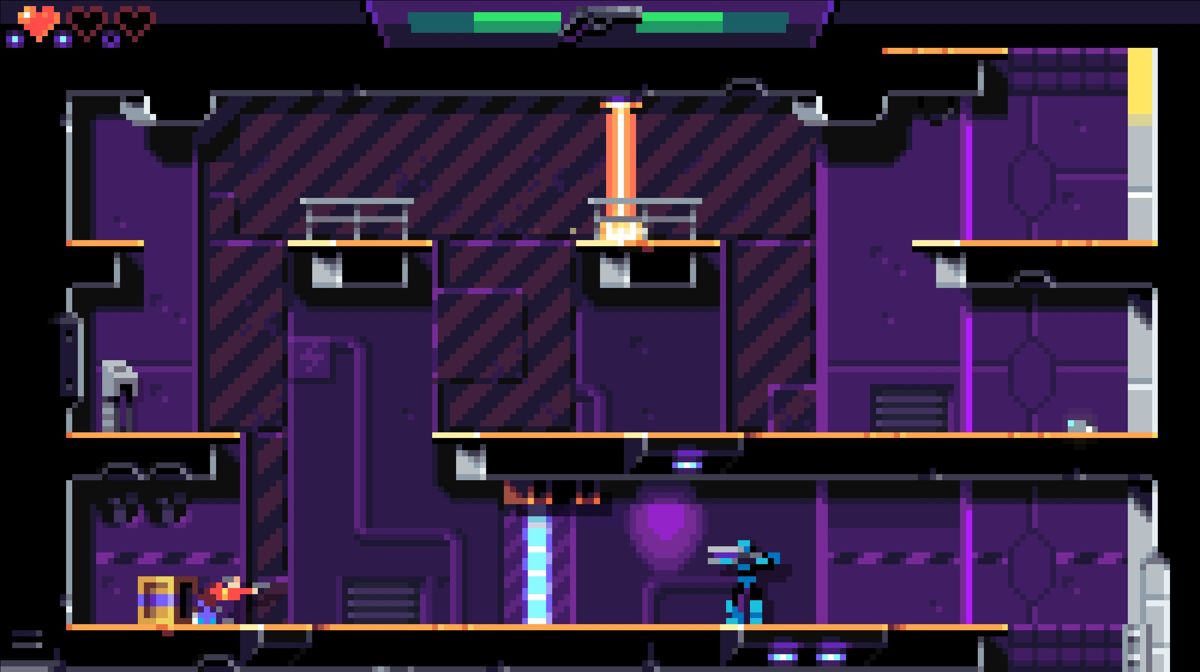
Lunark is one of the most passionate and personal love letters the cinematic platformer genre has ever received.
Developed by Canadian indie studio Canari Games, headed by solo developer Johan Vinet and published by WayForward Games, it is a lovingly crafted throwback to classic 2D cinematic platformers with a modern take — the kind of game that could only have been made by someone who grew up completely obsessed with Another World, Flashback, and Prince of Persia, and who spent years quietly dreaming about what a faithful modern successor might look like.
Jordan Mechner, the creator of Prince of Persia himself, noted that the game looks like something Éric Chahi could have made — and that is about as high a compliment as this genre can offer.

Year: 2023
Developer: Canari Games
Atmosphere: Sci-Fi · Dystopian · Lonely
Visual Style: Pixel Art · Rotoscope-Inspired Animation
Focus / Pace: Puzzle Platforming · Methodical
Platforms: PlayStation 4 · PlayStation 5 · Xbox One · Xbox Series X/S · Windows · Nintendo Switch
Why Lunark stands out
The creation of Lunark started in 2016, when Vinet began making pixel art demakes of classic games just for fun. His Game Boy mock-up of Flashback was the spark that convinced him he could make a real game. He launched a Kickstarter campaign in 2019, raising over 81,000 Canadian dollars, which attracted the attention of WayForward who offered him a publishing deal.
What makes the finished product so remarkable is not just the quality of the animation or the faithfulness of the genre recreation — it is the fact that Vinet personally filmed all of the rotoscope footage himself, acting out every movement and cutscene sequence due to the production’s small scope. He was, in effect, the sole developer, composer, pixel artist, animator, and motion capture actor for the entire project. The result speaks for itself.
The Story
Centuries ago, Earth became increasingly unsustainable and the most optimistic forecasts predicted that humans could survive for another ten years. In response, the moon was transformed into a moving space station — the Lunark — to save what remained of humanity. You play as Leo, a young courier with unique physical abilities who stumbles into a much larger conflict involving rebels, an authoritarian regime, and the ancient secrets buried within the Lunark itself.
The story hits the genre’s familiar beats — lone protagonist, oppressive world, a conspiracy that grows larger the deeper you go — and it does so with a lightness of touch that immediately sets it apart from its inspirations. Unlike many games with a dystopian theme, Vinet absolutely wanted to get away from the dark and dirty cliché. Lunark aims to be like its main protagonist: optimistic, adventurous, and sometimes funny, never taking itself too seriously. There are some genuinely great set pieces along the way — making your way through a runaway train, a prison break, exploring the Moon station itself — and the pacing keeps things moving with enough variety to hold your attention across its five-to-six hour runtime. Where the story falls slightly short is in its emotional depth. It is fairly generic and never ends up as engaging as it should be, particularly when compared to how seamlessly story weaves itself into gameplay in classics like Another World. But as a vehicle for delivering one gorgeous environment after another, it does its job well.
Graphics
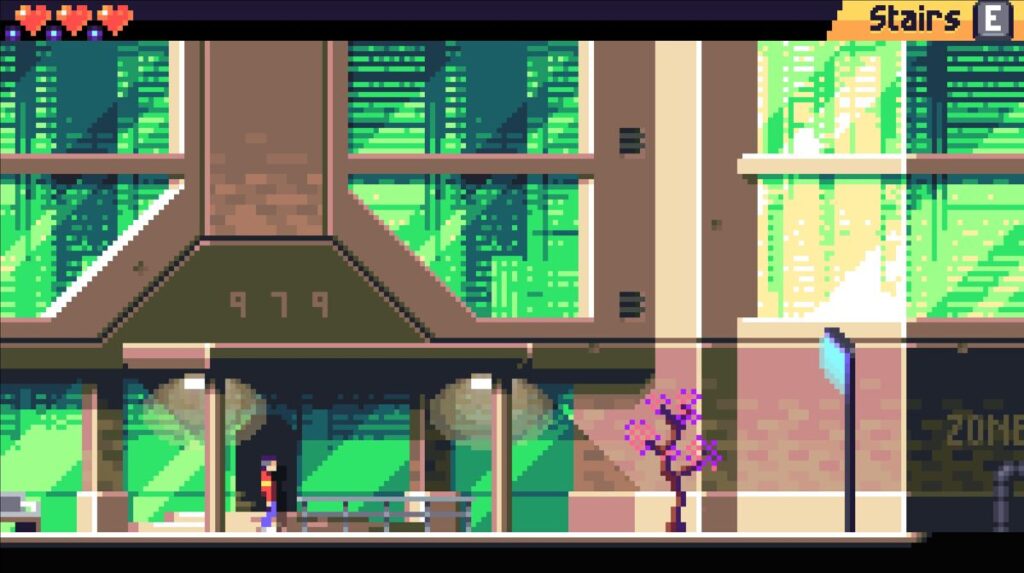
Lunark not only does all the things you would expect a good cinematic platformer to do, but it does them all extremely well. Character animations look great, with big chunky pixels moving in extra fluid animation using a high number of frames. The rotoscoping is particularly impressive in cutscenes, where the camera zooms in for close-up interactions. The fact that Vinet filmed himself performing every single one of those movements before painstakingly drawing pixels over the footage gives the animation a weight and physicality that is immediately recognisable to anyone who loves this genre.
The game’s setting and environments have a nicely done sci-fi aesthetic, looking somewhat familiar while appropriately alien. The colour palette is especially striking, with great use of purples and greens — just really good colour choices throughout. Vinet wanted the game to be attracted by a colourful and dynamic theme rather than a dystopian one, and that decision pays off visually in a way that makes Lunark feel instantly distinct from the darker, moodier entries in the genre. Every screen has been composed with the care and intention of someone who has spent years studying the classics — and it shows.
🏆 Did You Know?
Johan Vinet personally filmed all of the rotoscope footage for Lunark himself — acting out every movement, jump, and cutscene sequence before painstakingly drawing pixels over the footage. For a game built almost entirely by one person, he was simultaneously the sole developer, composer, pixel artist, animator, and motion capture actor.
Gameplay
Everything you would expect from the genre is here — environmental platforming puzzles, death-defying leaps, back-and-forth enemy battles, and so on. Leo moves with the deliberate, committed weight that defines the cinematic platformer tradition — every jump is a decision, every step forward a calculated risk. The game has 12 levels for the player to explore, with Leo able to shoot enemies, overcome traps, and solve environmental puzzles across a variety of distinct sci-fi environments.
Where Lunark genuinely impresses is in how thoughtfully it modernises the formula without betraying it. Little quality of life adjustments are present throughout — your character can climb platforms above you without the need to turn left or right first, and start and stop animations are considerably more forgiving than in the genre’s classic entries. The game’s respawn system is also very generous, bringing you back relatively close to where you died with infinite lives — a deliberate design decision by Vinet, who wanted the game to be approachable for players who might not have the time or energy to devote to the brutal difficulty of the 1990s originals. It is a smart set of compromises that make the game feel accessible without ever making it feel soft.
The one area that divides opinion is the save system. Several reviewers flagged the lack of an autosave at each checkpoint as a genuine frustration — though it is worth noting that a quality-of-life update released in May 2023 added additional checkpoints and a level select feature after beating the game. The combat, while functional, is the weakest part of the package — enemies can feel like speed bumps rather than genuine threats, and the shooting never quite reaches the tension of the traversal and puzzle sections.

Pacing
Lunark clocks in at around five to six hours, and that runtime feels carefully considered rather than thin. Vinet understood that the genre works best when it does not overstay its welcome — when every level introduces something new and keeps you moving forward with a sense of momentum and purpose. The variety of environments helps enormously here, shifting from urban dystopian corridors to jungle ruins to the vast interior spaces of the Lunark station itself, each with its own visual identity and mechanical focus.
The pacing does lean toward action over contemplation compared to some of its inspirations, which will suit some players more than others. Quieter exploratory stretches exist, but Lunark is fundamentally a game that keeps pushing you forward rather than asking you to linger. Even minor frustrations with the game cannot overshadow the joy of playing this unashamedly retro platformer — it is competently put together and lovingly crafted, and the imprecise controls and Leo’s occasionally sluggish movements feel like a feature rather than a bug. This is a game built by someone who genuinely loves this genre, and that enthusiasm is felt in every level.
Atmosphere
Lunark’s atmosphere is one of its most quietly impressive achievements, precisely because it resists the easiest version of itself. Where so many cinematic platformers reach instinctively for industrial grimness and oppressive darkness, Vinet deliberately steered toward something more colourful, optimistic, and adventurous — citing a personal tiredness with dark and pessimistic settings as one of the driving forces behind the entire project. The result is a sci-fi world that feels genuinely alive and inviting rather than threatening — dangerous in the way a great adventure film is dangerous, where the peril is real but the spirit of the protagonist never wavers.
The music was composed by Vinet himself, with inspiration drawn from Blade Runner, Vangelis, and other touchstones of cinematic science fiction. That influence is felt throughout — synth-driven and atmospheric, shifting between tense action cues and quieter, more contemplative ambient textures as the environments change around you. Combined with the vibrant pixel art and the fluid rotoscoped animation, the atmosphere of Lunark achieves something genuinely rare in the genre: it makes you feel like you are inside a great science fiction film from the early 1990s, filtered through the sensibility of someone who loved those films deeply and wanted to honour them properly.
🎮 My honest opinion on Lunark
Lunark is a remarkable achievement, made all the more remarkable by the circumstances of its creation. The idea that a single developer spent the better part of seven years — from those first pixel art demakes in 2016 all the way to the 2023 release — building this level of craft and ambition largely alone is genuinely humbling. It is easily one of the standout titles in recent years and a must-play for cinematic platformer fans, full of surprises and bound to leave lasting positive impressions.
Its limitations are real — the story never quite reaches the emotional heights of its inspirations, the combat is the weakest element of the package, and the save system caused unnecessary friction on launch. But none of that diminishes what Lunark gets so spectacularly right. It is a carefully crafted journey back to the narrative platformers of the early 1990s, with beautiful rotoscoped animation and a plot straight out of a Philip K. Dick novel. For anyone who loves this genre, Lunark is not optional — it is essential.
Where can I play Lunark?
Lunark is widely available across all major platforms. You can find it on PC via Steam, and on PlayStation 4, PlayStation 5, Xbox One, Xbox Series X/S, and Nintendo Switch through their respective digital stores. Limited Run Games also released physical versions and collector editions for Nintendo Switch, PlayStation 4, and PlayStation 5 — a treat for anyone who wants this one on their shelf. At a modest price point across all platforms, there is very little reason not to dive in.
Similar Games
If the rotoscoped animation, methodical sci-fi puzzle platforming, and loving genre craftsmanship of Lunark resonated with you, these two games are the essential next steps.
Flashback (1992)
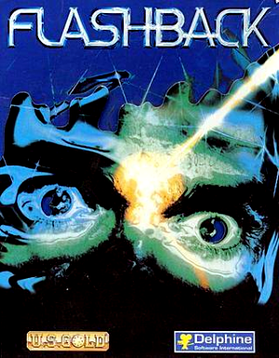
Flashback is the game Lunark wears most openly on its sleeve, and experiencing the original makes Vinet’s achievement all the more impressive. Its fluid rotoscoped movement, science-fiction world-building, and deliberate environmental puzzle-solving set a standard that Lunark chases faithfully — and if you love one, the other will feel like coming home.
Another World / Out of This World

Another World is the other half of Lunark’s creative DNA, and it remains one of the most purely cinematic experiences the genre has ever produced. Shorter, starker, and more abstract than Lunark, it approaches the same ideas of isolation, alien worlds, and wordless survival storytelling from a completely different angle — and it is absolutely essential reading for anyone the genre has hooked.
If you are drawn to games that combine faithful rotoscoped animation, colourful sci-fi world-building, and the specific satisfaction of cinematic platforming done with genuine love and craft, titles like The Eternal Castle Remastered, The Way, and Full Void offer wonderful alternatives that sit right alongside Lunark in the genre’s modern revival catalogue.