
Descripton
There is something almost uncomfortably personal about The Way. Right from its opening seconds — a man standing alone in the rain at his wife’s gravestone, before dropping to his knees and starting to dig — you know this is not going to be a typical sci-fi adventure. It is a game about grief, and about how far someone might go when they simply cannot accept that a person they love is gone. That is heavy territory for a pixel art platformer. And yet Puzzling Dream, a small Polish studio making what was essentially their debut, pulled it off with a conviction that still impresses me.
The Way is an unapologetic love letter to Another World, Heart of Darkness, and Flashback — three games that clearly left a deep mark on the people who made it. That influence is worn proudly on its sleeve, and in my opinion, that is entirely to its credit. This is a game that exists because someone missed a certain feeling and decided to bring it back themselves.

Year: 2016
Developer: Puzzling Dream
Atmosphere: Sci-Fi · Lonely · Melancholic Visual Style: Pixel Art · Retro Futurism
Focus / Pace: Puzzle Platforming · Deliberate
Platforms: Windows · macOS · Linux · Nintendo Switch
Why The Way stands out
The Way started as a Kickstarter campaign in May 2014, funded by 1,566 backers who pledged just over CA$20,000 — modest by any standard, but enough to make the game a reality. It launched on Windows in May 2016, eventually making its way to Nintendo Switch in 2019. What is remarkable about the finished product is not the budget or the scale, but the clarity of intention behind every design decision. This team knew exactly what they wanted to make and why. You feel that in every screen.
The Story
The game opens with Tom — your protagonist — standing before his wife’s grave in the rain. The first thing you actually do is pick up a shovel. He digs her up, brings her body home, seals her in a cryogenic pod, and starts planning what comes next. Because Tom and his wife, back when they were both deep space explorers, had found something on a distant planet — ancient writings hinting at a civilisation that had conquered death itself. He is going back. Whatever it takes.
I find this setup genuinely affecting in a way that games with much bigger budgets rarely manage. It is not subtle — but it does not need to be. The emotional stakes are established in the first two minutes without a single line of spoken dialogue, and from that moment on, the story carries a quiet weight through everything that follows. Tom’s inner thoughts surface occasionally as text floating above objects in the world, and the rest is told through environments and body language. It is very much in the tradition of its inspirations — the story lives in the spaces between the action, not in cutscenes that stop the game to explain things at you.
The central premise does something I really appreciate: it makes Tom’s grief feel irrational and completely understandable at the same time. He is doing something arguably wrong, arguably obsessive, and you root for him anyway. The story does not always reach the full emotional depth it is clearly aiming for, and the ending lands somewhere between ambiguous and unresolved. But that core situation — a man so stubborn in his love that he refuses to accept its ending — gives the whole journey a melancholy that sticks with you.

Graphics
Lunark not only does all the things you would expect a good cinematic platformer to do, but it does them all extremely well. Character animations look great, with big chunky pixels moving in extra fluid animation using a high number of frames. The rotoscoping is particularly impressive in cutscenes, where the camera zooms in for close-up interactions. The fact that Vinet filmed himself performing every single one of those movements before painstakingly drawing pixels over the footage gives the animation a weight and physicality that is immediately recognisable to anyone who loves this genre.
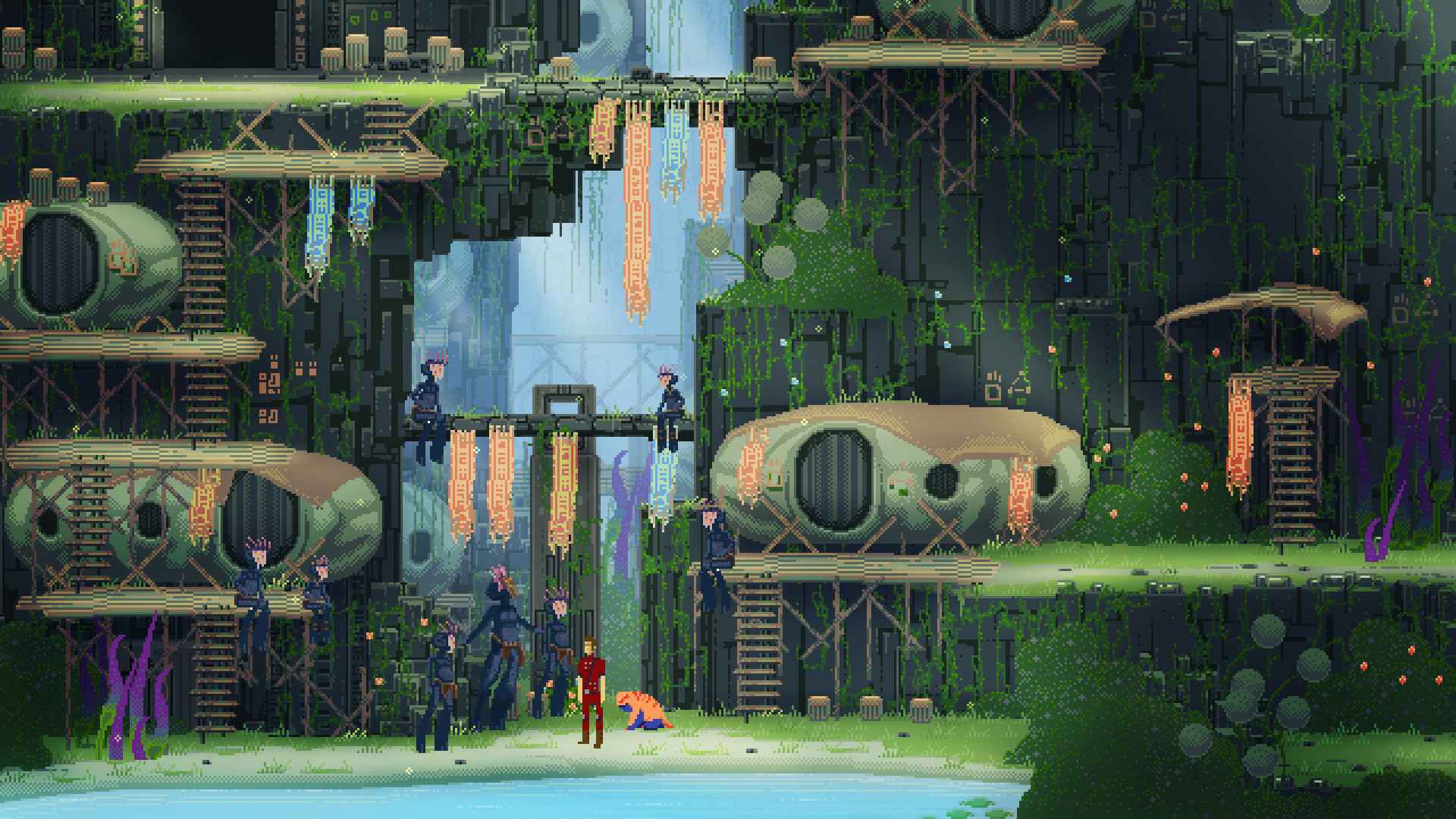
The game’s setting and environments have a nicely done sci-fi aesthetic, looking somewhat familiar while appropriately alien. The colour palette is especially striking, with great use of purples and greens — just really good colour choices throughout. Vinet wanted the game to be attracted by a colourful and dynamic theme rather than a dystopian one, and that decision pays off visually in a way that makes Lunark feel instantly distinct from the darker, moodier entries in the genre. Every screen has been composed with the care and intention of someone who has spent years studying the classics — and it shows.
🏆 Did You Know?
The Way won three awards at Pixel Heaven 2016 — Indie Grand Prix (best indie game), Rookie of the Year (best debut), and Retro Roots (best retro game). Not bad for a Polish studio’s first release, funded by just over CA$20,000 on Kickstarter.
Gameplay
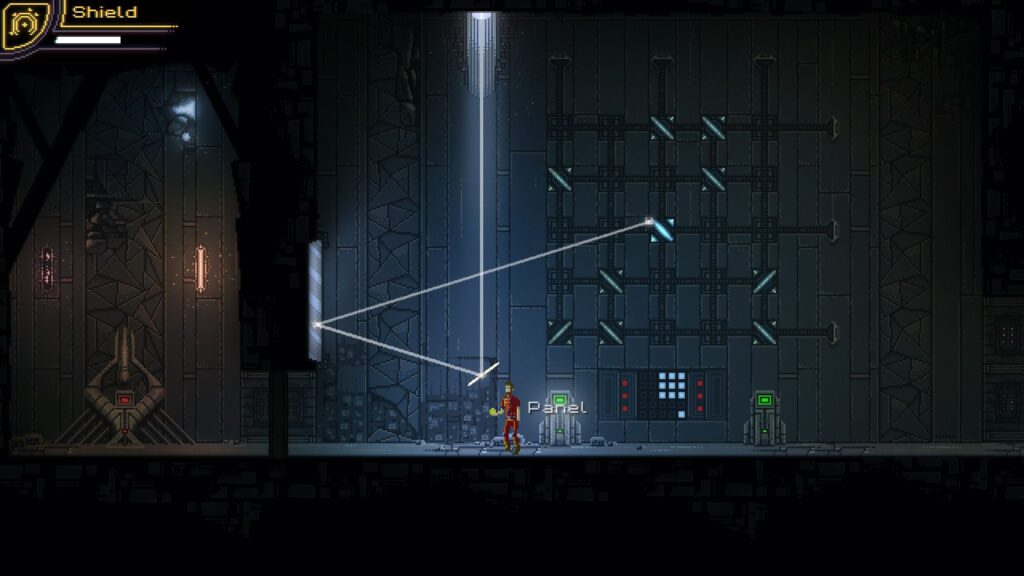
The Way is built around the three pillars of its genre: platforming, light combat, and environmental puzzles. Where it does something genuinely interesting is in the alien abilities Tom collects as he progresses. A telekinetic push. A teleportation dash. A laser that bounces off shield surfaces. Each new power transforms how you approach problems, and the game introduces them gradually — giving you time to understand what each one does before combining them.
This ability structure is, in my impression, the game’s most original contribution to the genre. Instead of the fairly standard run-jump-shoot toolkit of its inspirations, The Way keeps expanding what you can do right up until the final act. There is a robot programming puzzle fairly early on — where you script a sequence of actions for a machine to execute and adjust based on what went wrong — that is a genuine highlight. The kind of puzzle that makes you feel genuinely clever when you crack it.
Where things get rougher is the checkpoint system. Dying to an unexpected enemy at the end of a long platforming section and getting sent back to the start of it is a frustration that never fully goes away. The game sits firmly in the trial-and-error tradition of its inspirations — some deaths teach you something, others just feel arbitrary. Depending on your patience for that, your experience will vary.
Pacing
The Way is built around the three pillars of its genre: platforming, light combat, and environmental puzzles. Where it does something genuinely interesting is in the alien abilities Tom collects as he progresses. A telekinetic push. A teleportation dash. A laser that bounces off shield surfaces. Each new power transforms how you approach problems, and the game introduces them gradually — giving you time to understand what each one does before combining them.
This ability structure is, in my impression, the game’s most original contribution to the genre. Instead of the fairly standard run-jump-shoot toolkit of its inspirations, The Way keeps expanding what you can do right up until the final act. There is a robot programming puzzle fairly early on — where you script a sequence of actions for a machine to execute and adjust based on what went wrong — that is a genuine highlight. The kind of puzzle that makes you feel genuinely clever when you crack it.
Where things get rougher is the checkpoint system. Dying to an unexpected enemy at the end of a long platforming section and getting sent back to the start of it is a frustration that never fully goes away. The game sits firmly in the trial-and-error tradition of its inspirations — some deaths teach you something, others just feel arbitrary. Depending on your patience for that, your experience will vary.
Atmosphere
This is where The Way earns its reputation, at least for me. The atmosphere is melancholic in a way that feels genuine rather than performed — the quiet, specific grief of someone going through the motions of a world that has lost its colour. Tom moves through alien landscapes that are often visually stunning, but there is always an underlying loneliness to the whole journey.
The soundtrack is understated and ambient — synth-driven, slightly cold, with occasional moments of warmth that feel almost painful given the context. Some have noted it lacks variety, and there is truth to that. But I think the repetition is partly intentional. This is a journey with one emotional register, and the music reflects that honestly.
🎮 My honest opinion on The Way
The Way is an imperfect game that I think about more than a lot of much more polished ones. The checkpoint frustrations are real. Some puzzles are more opaque than they should be. The story does not always land with the precision it is reaching for. And yet — I genuinely love what this team made.
What gets me is how much heart is packed into such a modest production. A small Polish studio, a Kickstarter budget, a debut game — and they chose to make something about grief and obsession and the irrational things love makes us do. That ambition alone deserves respect. Combined with a pixel art world that is genuinely lovely to spend time in, an ability system that keeps things fresh, and an atmosphere that holds its melancholy all the way to the credits, The Way ends up being exactly what it set out to be.
For fans of the genre, it is absolutely worth your time. Just save often.
Where can I play The Way?
The Way is available on PC via Steam for Windows and Linux. Worth noting that macOS support has real limitations — it is not compatible with macOS 10.15 Catalina or above. A Nintendo Switch version arrived in May 2019 via the eShop. It is modestly priced and goes on sale regularly, so it is an easy one to grab when the moment is right.
Similar Games
The game The Way is most directly in conversation with. Shorter, starker, and more abstract, Another World tells its story of isolation and an unlikely bond with almost no words at all — and remains one of the most purely cinematic experiences the genre has produced.
Flashback (1992)
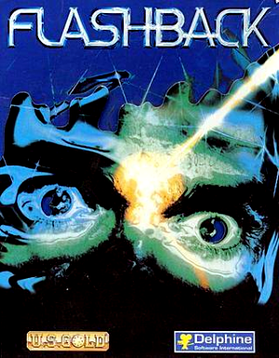
Flashback is probably the most direct reference point for The Way — more so even than Another World. The fluid rotoscoped movement, the sci-fi amnesia plot, the deliberate environmental puzzle-solving across an alien world — you can feel all of it in Tom’s journey. If The Way clicked for you, Flashback is essential, and experiencing the original makes Puzzling Dream’s achievement all the more impressive.
Heart of Darkness (1998)
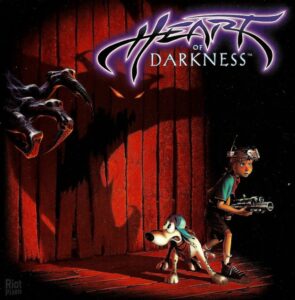
AThe other half of The Way’s creative DNA. Heart of Darkness shares its willingness to go to emotionally dark places — a child venturing into a nightmare world to save what he loves — while wrapping that premise in gorgeous hand-drawn animation and some of the genre’s most memorable set pieces.
If you are drawn to games that use deliberate platforming and alien environments to tell emotionally grounded human stories, Lunark, The Eternal Castle [Remastered], and Full Void are some of the best modern entries in this tradition.