
Description
There are games with interesting mechanics, and then there are games where the mechanic and the story are the same thing — where what you are doing with your hands is inseparable from what the game is asking you to think about. The Swapper is one of those games, and I find it genuinely remarkable that it pulls this off as quietly and as completely as it does.
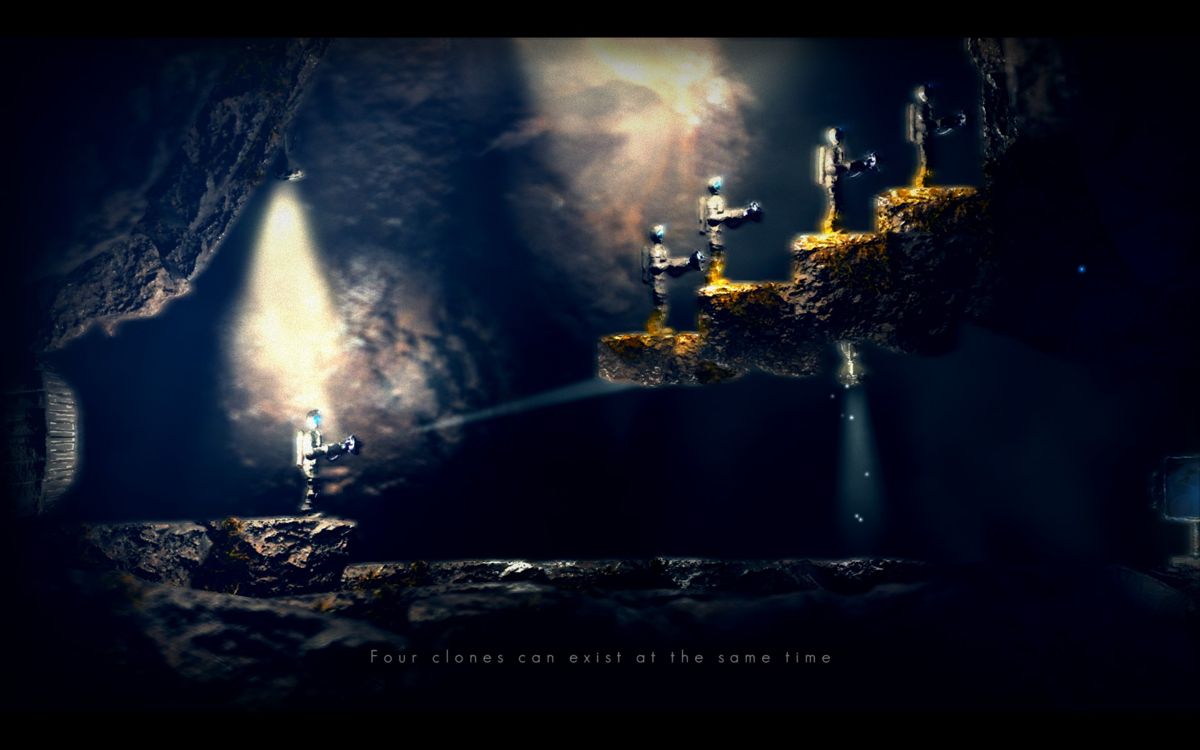
Developed by Facepalm Games — a Finnish studio that, at the time of making this, consisted essentially of two university students working in their spare time — The Swapper is a puzzle platformer set on an abandoned space station called the Theseus. You find a device that lets you create up to four clones of yourself and swap your consciousness between them. That is the entire game. One mechanic, five hours, and more genuine philosophical weight than most science fiction manages in two hundred pages.

Year: 2013
Developer: Facepalm Games
Atmosphere: Sci-Fi · Isolated · Thoughtful
Visual Style: Claymation-Inspired · Dark Minimalism
Focus / Pace: Puzzle Exploration · Slow-Paced
Platforms: Windows · macOS · Linux · PlayStation 3 · PlayStation 4 · PS Vita · Wii U · Nintendo Switch
Why Full Void stands out
I think what makes The Swapper genuinely special is that it never lets you forget what you are actually doing. Every time you send a clone to its death to solve a puzzle — and you will do this constantly — the game is quietly asking you: which one was really you? Was the one that survived the real one, or just the lucky one? Most games with cloning mechanics treat it as a cute gimmick. The Swapper treats it as a moral crisis, and the slow accumulation of that discomfort is one of the most interesting things I have experienced in this genre.
The Story
The Theseus station has been abandoned. Something happened here — something involving the crew, a set of alien rocks that may or may not be sentient, and the device now in your hands. The story unfolds through logs found on terminals, cryptic text that floats past the alien rocks as you walk by, and brief voice transmissions that raise more questions than they answer.
I will say this: the story demands patience. It is deliberately elliptical, and some of what it is doing only becomes clear in retrospect. But the payoff is real — the ending left me sitting quietly for a minute, which is more than most games manage. Two of the main characters are named after real philosophers Daniel Dennett and David Chalmers, both known for their work on consciousness and the mind-body problem, which tells you the level of intellectual seriousness the game is operating at. It is not subtle about its themes. But it earns them.

Graphics
Unlike anything else I have seen in the genre. The claymation visual style gives everything a physical weight and tactile texture that immediately sets The Swapper apart — surfaces look like they were made by hand, because they were. The space station feels genuinely alien and genuinely ancient at the same time, which is a difficult combination to pull off.
The lighting is particularly impressive — dynamic and atmospheric, shifting as you move through the station in ways that feel genuinely purposeful rather than decorative. Given that the colored light system is also the core mechanical limitation of the puzzle design, the fact that it is also visually beautiful is a remarkable piece of cohesion.
🧠 Did You Know?
The entire visual world of The Swapper — every platform, every corridor, every piece of the space station — was physically built out of clay and everyday household materials by designer Olli Harjola, photographed, and then rendered into the game with dynamic lighting. Harjola has said he does not like 3D modelling but loves working with his hands, so he simply made the game’s world as a physical object first.
The result is a visual texture that no digital tool could replicate — and one of the most distinctive art styles in the history of the genre. Oh, and the original concept for the whole game came from a novel called A Living Soul, about a brain in a jar. Which tells you everything you need to know about the kind of game this is.
Gameplay
The mechanic is elegant: create clones, swap consciousness into them, use their positions to reach orbs or trigger switches. Clones mirror your movements exactly, which means every puzzle is really about geometry — where do I need copies of myself to be, and how do I get them there without killing them?
The cloning mechanic is one of the most inventive in the genre — see why it earned its place among the most inventive cinematic platformers ever made.
The complication comes from the colored lights. Blue light stops you creating clones in an area. Red light stops you swapping into one. Purple blocks both entirely. At first this feels like an arbitrary restriction. By the mid-game I noticed it forces a completely different kind of thinking — working around the lights rather than through them — that keeps the puzzle design fresh throughout. And then gravity inversion shows up, and things get genuinely tricky.
I think the puzzle difficulty sits in exactly the right place for most of the game — challenging enough to make you feel clever when you solve something, never so obtuse that you want to put it down. There are a handful of moments where the solution requires pixel-perfect clone placement that can feel more fiddly than satisfying, but they are rare enough not to define the experience.

Pacing
At around five hours, The Swapper is perfectly paced. It never rushes, never lingers. New puzzle elements are introduced at just the right intervals to keep things feeling fresh, and the Metroidvania-lite structure — using the map to backtrack and unlock previously inaccessible areas as you collect more orbs — gives the whole thing a satisfying sense of cumulative progress. I played it in two sittings and both times I found it difficult to stop at a natural break point, which I think is the best thing you can say about a puzzle game’s pacing.
Atmosphere
Exceptional. The sound design does most of the heavy lifting here — ambient, sparse, and genuinely unsettling in the quieter moments.
The score by Carlo Castellano complements the visual style perfectly: calm on the surface, with an undercurrent of something deeply wrong that never fully resolves. Combined with the claymation visuals and the sense of being entirely, irreversibly alone in a space station that used to be full of p
🎮 My honest opinion
I think The Swapper is one of the most quietly brilliant games in this genre, and I suspect it is underappreciated precisely because it does not announce itself loudly. It looks unusual, it moves slowly, and it asks you to sit with some genuinely uncomfortable ideas. None of that makes for an easy sell.
But if you give it the attention it deserves, it delivers something rare: a puzzle mechanic that is not just clever but genuinely meaningful, tied to a story that is actually about what the mechanic makes you do. The clay world, the philosophical character names, the ending that does not fully explain itself — it all hangs together with a confidence that is remarkable for a game made by two people in their spare time. I love it!
Games similar to The Swapper
The Swapper is available on PC via Steam, as well as on PlayStation 3, PlayStation 4, PS Vita, and Nintendo Switch. It is modestly priced and completable in a single focused evening — making it one of the best value propositions in the genre.
Games similar to Full Void
Inside (2016

Inside is the closest companion piece to The Swapper in the modern genre — another atmospheric puzzle platformer that uses its central mechanic to say something genuinely dark about identity and control. Both games are short, slow, and significantly more disturbing than they initially appear.
The Eternal Castle Remastered (2019)
![The Eternal Castle [REMASTERED] Cover](https://cinematicplatformers.com/wp-content/uploads/2026/04/The-Eternal-Castle-Cover-300x172.jpg)
If the claymation visual distinctiveness of The Swapper is part of what drew you in — a game that looks completely unlike anything else — The Eternal Castle Remastered operates in the same spirit: a game built around a very specific visual identity that feels genuinely handcrafted and completely its own.
If you are drawn to cinematic platformers that use their mechanics to ask real questions — games that leave you thinking rather than just satisfied — DARQ, Inmost, and 7th Sector all share that same introspective, atmospheric corner of the genre.