

Oddworld: Abe’s Oddysee is one of the most original, audacious, and flat-out strange games the cinematic platformer genre has ever produced — and I mean that as the highest possible compliment. Developed by the aptly-named studio Oddworld Inhabitants, Abe’s Oddysee was planned to be the first installment in a five-part Oddworld Quintology, and from its very first moments it announces itself as something genuinely unlike anything else.
It focuses on the portrayal of a weak, underpowered character in a grim and hostile world, who has to rely on his cunning to outwit enemies and overcome hazards — and it wraps all of that inside a darkly satirical universe that skewers corporate greed, industrial exploitation, and environmental destruction with a wit and intelligence that still feels razor sharp today.

Year: 1997
Developer: Oddworld Inhabitants
Atmosphere: Industrial · Grotesque · Darkly Humorous
Visual Style: Pre-rendered 2.5D · Gritty
Focus / Pace: Stealth · Puzzle-Platforming · Precise
Platforms: PlayStation · Windows
Why Oddworld: Abe’s Oddysee stands out
There’s an obvious environmental, sociopolitical element to the game — but what Oddworld managed to do so effectively is express these themes without ever feeling self-righteous. It has a good balance of imagination and humour to go along with the political aspects, which prevents the game from feeling too pretentious or in love with itself.
Beyond its themes, the game introduced two mechanics that the genre had simply never seen before. Abe can issue orders to his fellow Mudokon buddies using GameSpeak — commands like “follow me”, “wait”, and even fart — and he can possess enemies and control them, with all creatures having their own set of words that become important puzzle-solving tools. These two ideas alone would have been enough to make Abe’s Oddysee memorable. Together, they make it iconic.
The Story
Abe is a Mudokon, a member of a once prosperous race which has now been enslaved by the Glukkons, forced to work in their huge corporations. The food factories have found a new type of meat, delicious to all the inhabitants, though no one knows the recipe. Following his stomach, Abe eavesdrops on the corporate leaders’ conversation and makes the most frightening and disgusting discovery: his own race is that secret delicious food. Spotted by the guards and now a marked target, Abe has no choice but to run — but he cannot bring himself to leave his fellow Mudokons behind to face the same fate.
What makes the story so effective is how economically it is told. There is no lengthy exposition, no dialogue-heavy cutscenes explaining the lore. The game does a terrific job of giving the player a good insight into its world with very little exposition — Rupture Farms is the biggest meat processing plant on Oddworld, and the environment itself communicates everything you need to know about the horror of what happens there. The satirical underpinning — a world of enslaved workers, indifferent corporate overlords, and products made from the suffering of the vulnerable — gives the whole journey a moral urgency that makes Abe’s mission feel genuinely worth fighting for.
Graphics
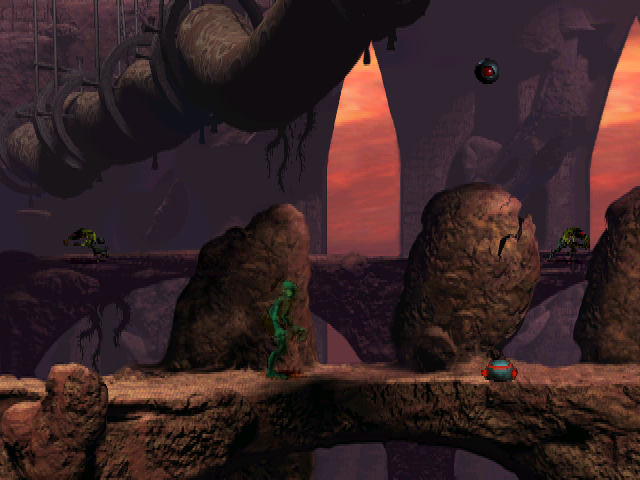
Abe’s Oddysee epitomises the phrase “every frame a painting” and deserves a spot among the most gorgeous cinematic platforming games ever made. The pre-rendered 2.5D visual style gives the game a richness and depth that few of its contemporaries could match, and the industrial environments of Rupture Farms — rusted machinery, flickering neon signage, smoke-stained corridors — are designed with an extraordinary level of detail and creative invention.
What impresses me most is how fully realised the visual world of Oddworld feels. Every creature, every environment, every background element has been considered as part of a coherent, lived-in universe. For an original PlayStation game it has aged remarkably well — the decision to go for a pre-rendered look was a good one, and even the FMV cutscenes still hold up, partly because the creators came from animation backgrounds in TV and film. The character design in particular is extraordinary — grotesque and inventive and darkly funny all at once, in a way that feels completely unique to this series.
Gameplay
Abe’s Oddysee doesn’t play like a Super Mario game. Abe must be carefully moved around, his every action planned beforehand, and each button press precisely and correctly timed. He is a weakling who can’t jump more than one or two meters, can’t fall from too great a height, and isn’t very fond of bullets — or claws, or sharp machine parts. That deliberate fragility is the entire point. Every screen demands observation before action, and rushing headlong into any situation is almost always fatal.
Abe’s only special power is chanting, which he can use to stun certain enemies or possess them entirely. Possession is where the game gets genuinely brilliant — slipping inside the mind of a heavily armed Slig and using his own firepower against his companions before detonating him in a shower of grotesque comedy is one of the most satisfying mechanics the genre has ever produced. You can’t chant in all areas because there will be countermeasures to stop you, which forces you to constantly think outside the box. Beyond possession, Abe can run, jump, climb, tiptoe, crouch, and roll — and in most areas, all of these actions are essential to survival, alongside throwing stones to confuse enemies and luring them into traps.
The one area where the game genuinely shows its age is the checkpoint system. Sometimes you will find yourself going back several screens just for dying on a trial-and-error segment, and the punishment for a single mistimed jump or an enemy you did not see coming can feel genuinely disproportionate. It is a design quirk firmly rooted in its era, and one that will test the patience of modern players more than almost anything else in the game.

Pacing
Abe’s Oddysee moves at a slow, deliberate, and completely uncompromising pace — and it wears that uncompromising quality like a badge of honour. While definitely a platformer, it also plays like a puzzler, so it’s not just about pulling off the move, but thinking what move that should be. The level design is such that each segment, no matter how hard, is also immensely fun — as long as you don’t mind repeating some of them.
What keeps the pacing from ever feeling monotonous is the sheer variety of what the game asks of you. Stealthy sections where you tiptoe past sleeping Sligs alternate with possession puzzles, frantic escape sequences, and quieter environmental traversal across the wilder landscapes of Oddworld beyond the factory walls. The difficulty slowly ramps up the further you get, giving you just enough time with each new mechanic to feel confident before the game tightens the screws again. It is a rhythm that demands patience but rewards it generously.
Atmosphere
Oddworld: Abe’s Oddysee has one of the most distinctive and fully realised atmospheres in the entire genre. This game has such a uniquely sober, depressing, and contemplative mood to it, consistent in every aspect from the audiovisuals down to the interactions with the Mudokons. It is a piece of evocative art come to life. The industrial horror of Rupture Farms — the grinding machinery, the corporate signage cheerfully advertising products made from enslaved beings, the absolute indifference of the Glukkons to the suffering around them — creates a world that feels genuinely oppressive without ever losing its darkly comedic edge.
What makes the atmosphere so memorable is that tension between grimness and humour. Abe farts. Mudokons crack jokes. Sligs bicker with each other like bored factory workers. And yet underneath all of that, the world is a deeply sad place — a civilisation built on exploitation, running out of resources because it has consumed everything around it without a second thought. That combination of the grotesque, the funny, and the quietly tragic gives Oddworld a tonal identity that no other game in the genre has ever quite managed to replicate.
🎮 My opinion on Oddworld: Abe’s Oddysee
Oddworld: Abe’s Oddysee is one of those games that feels genuinely irreplaceable. You could not make it today and have it feel the same — it belongs to a specific moment in gaming history when developers were taking wild creative swings, building entirely original universes from scratch, and trusting players to meet them on their own terms. Oddworld Inhabitants said they wanted to make people feel something rather than simply feel like they won — and they absolutely succeeded.
The checkpoint frustrations are real, and I will not pretend otherwise. But they are a small price to pay for a game this inventive, this atmospheric, and this committed to its own strange, satirical vision. Tight controls fitted alongside unique possession and GameSpeak mechanics make for an incredibly captivating gameplay experience, and pairing this with a world positively dripping with grim but fantastical lore crafted as a metaphor for real-world worker exploitation cements this as an instant classic that not only stands up today, but begs a revisit. If you have never played Abe’s Oddysee, you are missing one of the most original games ever made.
Where can I play it?
If the dark industrial satire, stealth-driven puzzle platforming, and grotesque world-building of Abe’s Oddysee resonated with you, these two games belong on your list immediately.
Games similar to Heart of Darkness
If the dark fairytale atmosphere, hand-drawn animation, and brutal trial-and-error challenge of Heart of Darkness resonated with you, these two cinematic platformers deserve your attention next.
Oddworld: Abe’s Exoddus
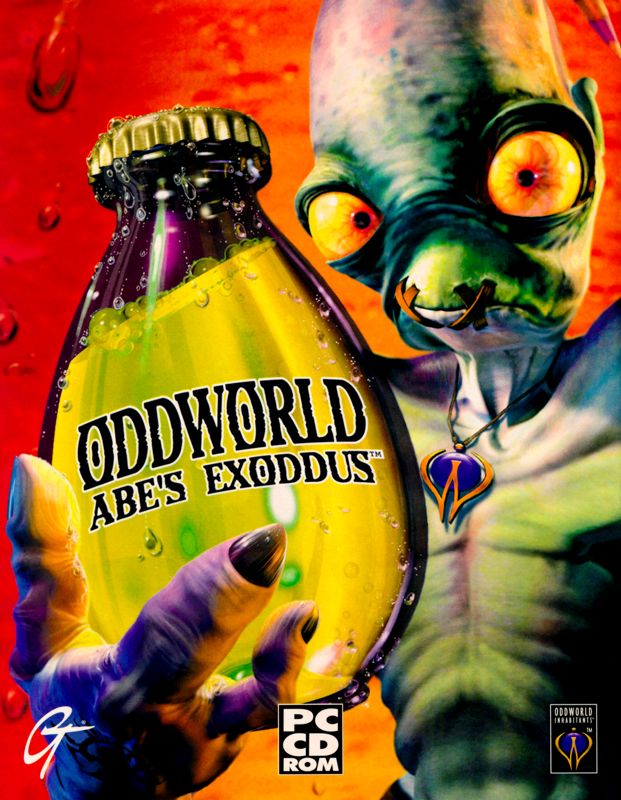
The direct sequel to Abe’s Oddysee is the natural next step, expanding everything that made the original great — more Mudokons to save, more possession puzzles, more darkly comic world-building — while addressing the checkpoint frustration that held the first game back with a far more generous quicksave system. If you loved Abe’s Oddysee, Exoddus is essential.
Inside
Inside shares Abe’s Oddysee’s core preoccupation with control, exploitation, and what it means to be a body in a system that treats living beings as resources. Its minimalist presentation and wordless storytelling approach the same themes from a completely different angle — quieter, stranger, and even more unsettling — making it the perfect modern companion piece to Abe’s journey.
If you are drawn to games that combine stealth-driven traversal, darkly satirical world-building, and the specific pleasure of outsmarting a world that is overwhelmingly stacked against you, titles like Blackthorne, Another World, and Oddworld: Soulstorm offer wonderful alternatives that sit right alongside Abe’s Oddysee in the genre’s essential catalogue.