
Descripton
Unto the End is the kind of game that will make you put your controller down in frustration and pick it back up twenty minutes later, because you simply can’t stop thinking about that last encounter and what you did wrong. Made by husband-and-wife team Stephen Danton and Sara Kitamura — the entirety of 2 Ton Studios, based in Canada — it is a survival combat platformer set in a brutal, wordless world of frozen mountains, dark caves, and creatures that want you dead. Or maybe just want you gone. The distinction matters more than you’d expect.
The pitch is about as stripped back as it gets: you are a father, you need to get home to your family. That’s it. What follows is one of the most uncompromising games I’ve played in this genre — deliberate, punishing, and quietly extraordinary when it clicks.
Year: 2020
Developer: 2 Ton Studios (Stephen Danton & Sara Kitamura)
Atmosphere: Harsh · Lonely · Tense
Visual Style: Stylized 2.5D · Minimalist Animation
Focus / Pace: Survival Combat · Deliberate
Platforms: PlayStation 4 · Xbox One · Windows · Nintendo Switch · Google Stadia
The Story
The setup takes ninety seconds. A man leaves his home in a snowstorm, goes hunting, something goes wrong. You wake up deep inside a mountain, alone, with a sword. The goal: get back to your family.
There is no dialogue, ever. What little story exists is told through environments and the creatures you encounter — and those creatures are more interesting than they first appear. They have territories, communities, reactions that shift depending on how you behave. Some will trade with you. Some just want you out of their space. One encounter can go half a dozen different ways depending on what you do, and the game never tells you which.
The ending, when it comes, lands harder than it has any right to given how little the game has told you directly. I think that’s because you’ve earned it — every painful step of the way back was yours, not the game’s. That makes the arrival feel genuinely meaningful.
Graphics
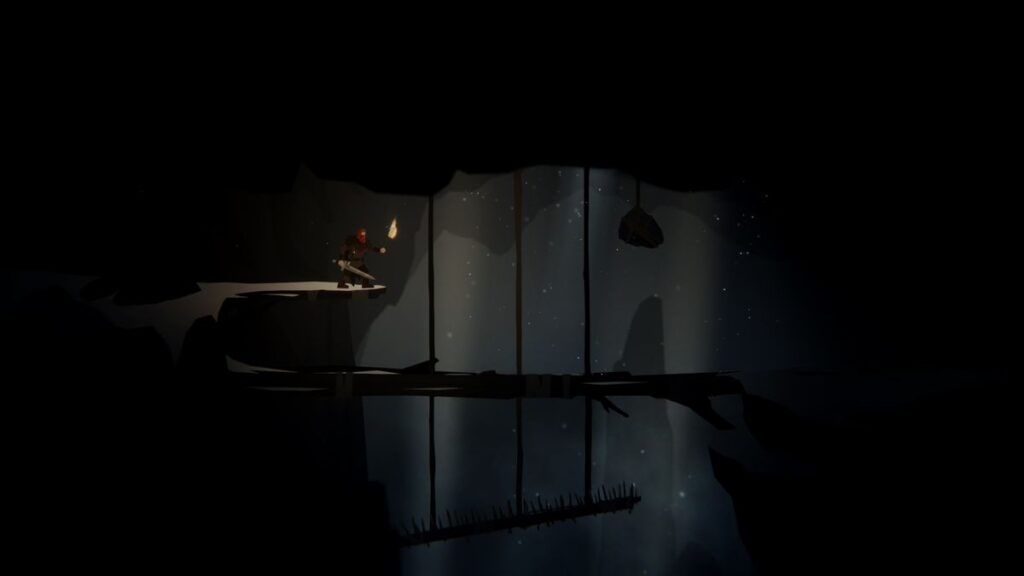
Unto the End has a visual style that I’d describe as concept art in motion. The art direction draws inspiration from painters like John Harris and the work of animator Genndy Tartakovsky — big, stark silhouettes against atmospheric backgrounds, with just enough detail to make the world feel real without ever trying to mimic it. The result sits somewhere between a moving illustration and a storyboard, and I think it’s genuinely beautiful in a way that snuck up on me.
The environments shift from snow-blasted mountain passes to pitch-black cave systems to underground ruins, and each one has its own distinct mood. The outdoor sections in particular — grey sky, snowfall, distant treelines rendered as dark smudges — have a cold, lonely quality that I found more affecting than a lot of more technically ambitious games manage. There’s a rawness to it that suits the subject matter perfectly.
What impresses me most is what the game does with light. Torches are a practical necessity in the cave sections, but they also do enormous atmospheric work — a small pool of warm orange against total darkness, shadows shifting as you move. Drop your torch mid-fight and suddenly you can barely see what’s coming at you, which is both terrifying and entirely intentional.
The character animation deserves a mention too. The father moves with a weight and physicality that reminds me a little of the original Prince of Persia — not fast, not heroic, just a man doing his best to survive. Every stumble, every laboured breath after a hard fight, every moment he steadies himself before a big jump feels considered. For a two-person studio, the level of craft here is remarkable.
Gameplay
This is where Unto the End either wins you over completely or loses you, and I think it’s worth being upfront about that before anything else.
The combat system is the centrepiece of everything. It’s built around reading your opponent — watching for tells, timing your blocks and counters, choosing your moment. Every move the father has is available from the very first minute: high and low attacks, blocks, a dodge roll, a shoulder barge, feints, a throwable dagger. The game doesn’t drip-feed you abilities. What it does instead is throw you into encounters where you will die — repeatedly, sometimes brutally — until you understand what you’re looking at.
This reminded me strongly of Flashback’s combat in spirit, if not in execution — that same sense that every encounter is a small puzzle to be solved rather than a reflex test to be passed. But where Flashback gives you a gun and some distance, Unto the End puts you in close, face to face, and demands you learn each opponent’s specific rhythm before you can reliably beat them. It’s closer in feel to a 2D Dark Souls than anything else in this genre — a comparison the developers themselves seemed aware of and deliberately sidestepped, because the system really is its own thing.
What surprised me most was the non-combat layer. Sheath your weapon and you signal peaceful intent. Some creatures will trade, others will let you pass if you read the situation right. Get it wrong and a peaceful interaction turns hostile instantly, with no warning. I found this quietly thrilling.
The bleeding mechanic gives every fight a real cost — take a hit, start losing health until you treat the wound or reach a campfire. I died more than once not from an enemy directly but from walking wounded into the next encounter. That sting felt earned.
Play with a controller. There’s also a Combat Assist option that slows enemy attacks slightly — worth knowing it exists.

Pacing
Unto the End runs around three to four hours if you know what you’re doing — longer on your first run, where death will pad that out considerably. The game is linear in structure but hides enough branching paths, secret areas and optional encounters that exploration feels rewarding rather than railroaded.
My honest feeling is that the pacing is uneven. The opening hours are tense and well-judged, with encounters spaced out enough that each one feels like an event. But the middle stretches — long cave sections with back-to-back fights and limited campfires — can start to feel exhausting rather than tense, especially if your supplies are running low. When the game opens up again into outdoor environments, the relief is almost physical.
The brevity is both a strength and a weakness. I wanted more world. But I also think a longer game would have struggled to sustain the same intensity — so I’ll take the three hours we got.
Atmosphere
Unto the End’s atmosphere is built almost entirely from sound and silence, and it does it better than most. There is no music during gameplay — just wind, footsteps, the scrape of a sword being drawn, the distant growl of something you haven’t seen yet. It creates a specific kind of dread that a conventional soundtrack would have completely undermined.
The world feels genuinely hostile in a way I find rare. Not hostile in a designed-to-frustrate way, but hostile the way a real wilderness feels — indifferent to you, operating on its own logic, full of things that were here long before you arrived and will be here long after. The creatures you encounter contribute to this enormously. They feel like inhabitants rather than obstacles, and that small shift in framing changes the atmosphere of the whole game.
I’ll also mention the small detail that the in-game text can be switched to Scottish Gaelic — the father’s implied native language. Nobody is going to notice that unless they go looking for it, but the fact that 2 Ton Studios put it there at all tells you something about the care that went into building this world.
🎮 My honest opinion on Unto the End
Unto the End is not going to be for everyone, and I think the people who bounce off it do so for completely legitimate reasons. The combat asks a lot. The darkness of the cave sections can be genuinely fatiguing. And the game offers almost no scaffolding — no map, no waypoints, no explanations. If that sounds like a dealbreaker, it probably is.
But for me, it landed. There’s something about the complete absence of handholding that makes every small victory feel disproportionately satisfying. The first time I correctly read an enemy’s tell and countered cleanly, I felt it. The first time I talked my way out of a fight by sheathing my weapon at the right moment, I felt that too. Unto the End is a game that trusts you completely, and that trust — rare and occasionally infuriating as it is — is what makes it stick.
What I keep coming back to is the origin story. Two people, leaving stable careers, travelling through Europe and South America for years teaching themselves game development from scratch, building something this considered and this specific as their debut. Stephen Danton spent twelve years at Microsoft before this. His wife Sara ran an interior design business. Unto the End is what they made when they decided to bet on themselves instead. That ambition is visible in every frame.
It’s flawed, it’s short, and it will make you want to throw your controller at least once. I still think it’s one of the most interesting games in this genre — precisely because it refuses to behave like one.
Where Can I Play Unto the End?
Unto the End is available on PC via Steam and GOG, PlayStation 4, Xbox One, and Nintendo Switch. The PC version is your best bet for the smoothest experience, though the console versions hold up well — just make sure you’re playing with a controller regardless of platform. It was also a day one Xbox Game Pass title, so if you have a subscription it may already be waiting for you. It’s modestly priced and frequently on sale, which makes the short runtime much easier to swallow. Worth every penny at a discount.
Similar Games
If Unto the End resonated with you, these two games share its core qualities — wordless worlds, deliberate movement, and the specific satisfaction of a game that refuses to hold your hand.
Flashback (1992)
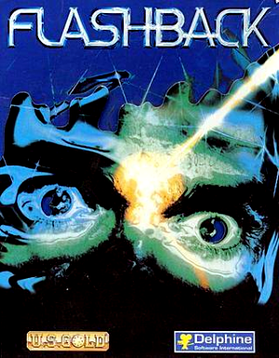
Unto the End wears its love for 1990s cinematic platformers openly, and Flashback is the clearest point of comparison — the same deliberate movement, the same sense that every encounter is a problem to be solved rather than a reflex to be tested, the same lonely protagonist in a hostile world. If Unto the End made you want to go back to the genre’s roots, Flashback is the obvious first stop.
The Cub (2023)

Less combat-focused than Unto the End but sharing the same core DNA — a wordless world, a protagonist with no special powers just trying to survive, environmental storytelling that trusts you to piece things together. The Cub is warmer in tone but carries the same respect for the player’s intelligence. A natural companion piece.