
Descripton
Bermuda Syndrome is one of those mid-90s PC games that slipped through the cracks almost entirely, surviving mainly as a fond memory among European players who stumbled across it in magazine coverdiscs.
Developed by Century Interactive and published by BMG Interactive in 1995, it is an unabashed Flashback clone — same rotoscoped movement, same screen-by-screen structure, same deliberate cinematic pacing — transplanted into a premise that is gloriously pulpy: a World War II bomber pilot crash-lands through a dimensional portal into a lost world full of dinosaurs, and has to escort a princess back to civilisation. It is B-movie nonsense delivered with genuine craft, and it is considerably more interesting than its obscurity suggests.

Year: 1995
Developer: Century Interactive Atmosphere: Sci-Fi · Survival · Hostile
Visual Style: Rotoscoped Animation · Detailed Pixel Art
Focus / Pace: Puzzle Platforming · Methodical
Platforms: MS-DOS · Windows
Why Bermuda Syndrome stands out
By 1995 the cinematic platformer genre was already settling into familiar patterns — rotoscoped movement, sci-fi amnesia plots, grey industrial corridors. Bermuda Syndrome sidesteps all of that by throwing its protagonist into a lush prehistoric jungle and framing the whole thing as a 1940s serial adventure. Jack Thompson is no brooding amnesiac — he is a wisecracking American pilot who decapitates a T-Rex with his crashing plane in the opening minutes and immediately starts flirting with the princess he just saved. The tone is knowingly pulpy in a way that gives the game a distinctive personality most of its genre peers lack.
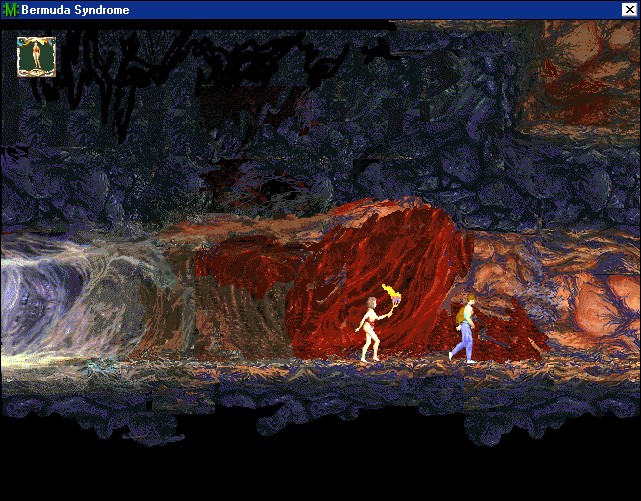
What also sets it apart is the companion mechanic. Natalia — the princess — follows Jack throughout the entire game, and many puzzles require you to position or interact with her to progress. It is a rougher, earlier version of the kind of companion-based puzzle design that later games in the genre would develop more elegantly, but it works more often than it does not, and it gives the journey an odd warmth that the lone-protagonist formula rarely achieves.
The Story
It is 1942. Jack Thompson’s bomber is shot down over Germany during a mission, a mysterious portal opens in the sky, and he crash-lands into a dense tropical jungle populated by dinosaurs and hostile natives. His plane, in falling, decapitates a T-Rex that was about to devour Natalia — a princess who was being offered as a sacrifice. She joins him, and together they have to find a way out of this lost world.
The story is pure B-movie — and I mean that fondly. The dialogue is entertainingly overwrought, the relationship between Jack and Natalia plays out like a 1940s adventure serial, and the whole thing leans into its pulpy premise with a confidence that keeps it charming rather than tiresome. It will not move you the way Another World does. But it has more personality than most of its contemporaries, and the setting — a lost prehistoric world rather than a dystopian future — gives it a visual and narrative identity that still feels distinct thirty years later.
The game ends on a direct promise of a sequel. That sequel was never made, almost certainly because Bermuda Syndrome did not sell well enough to justify one. It is a loose end that still stings a little.
Graphics
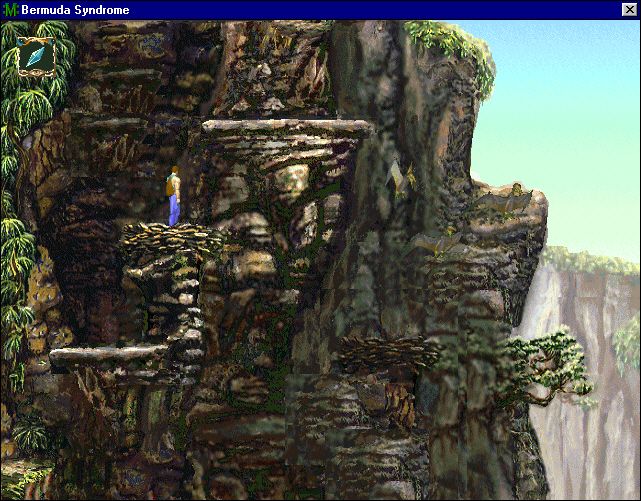
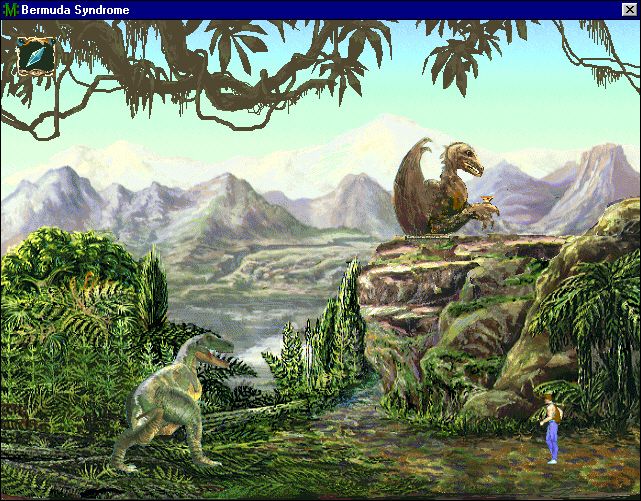
This is where Bermuda Syndrome genuinely earns its reputation. The pre-rendered backgrounds across the game’s 250-plus screens are lush, detailed and full of colour — tropical jungles, ancient ruins, underground caverns — each one composed with obvious care. Coming Soon magazine at the time called the backgrounds the most delightful aspect of the game, and that assessment still holds up.
The character animation, courtesy of those former Disney artists, is the other standout. The dinosaurs in particular move with a weight and personality that feels remarkable for 1995 — each creature has its own physicality, and watching a T-Rex lumber across the screen still impresses. Jack himself moves with the deliberate, committed weight of the rotoscoped tradition, though the sprites have a slightly plastic quality that stops short of Flashback’s smoothness.
🏆 Did You Know?
The creatures and characters in Bermuda Syndrome were animated by former Disney artists — a fact that explains why the dinosaurs in particular move with an expressiveness and personality well beyond what most PC games of 1995 could manage. That pedigree shows in every frame, and it remains the game’s most immediately striking quality even today.
Gameplay
Bermuda Syndrome plays almost exactly like Flashback — screen-by-screen progression, deliberate movement, a mix of environmental puzzles and combat encounters, no hand-holding. Jack starts with only a knife, acquires a gun early on, and must use both alongside the environment and Natalia to solve the problems in his path.
The early sections handle encounters as puzzles rather than straight combat — shoot a pterodactyl to distract a hungry dinosaur, wound a creature to lure it into an environmental trap. This is the game at its most inventive, and it works well. The second half leans more heavily on gunplay, which drains some of the tension — the gun makes combat more predictable and less interesting than the improvised solutions the first half demands.
The puzzles involving Natalia are hit and miss. When they work, they give the game a texture that solo cinematic platformers lack. When they do not, her unreliable pathfinding becomes a source of genuine frustration. The difficulty throughout is firmly in the genre’s unforgiving tradition — save often, expect to die, expect to learn from it.
Atmosphere & Pacing
The atmosphere is one of Bermuda Syndrome’s quiet achievements. The lost world setting — all dense jungle canopies, ancient stone structures, and strange skies — gives it a visual identity unlike anything else in the genre, and the lush backgrounds sustain that throughout. It feels genuinely exotic in a way that the grey corridors of most cinematic platformers do not.
Pacing is brisk for the genre. The screen-by-screen structure keeps things moving, and the variety of environments — jungle, ruins, underground caves — stops the experience from settling into repetition. The tonal shift in the second half, where puzzle-solving gives way to more conventional shooting, does disrupt the rhythm somewhat. But the game is not long enough for that to become a serious problem.
🎮 My honest opinion: Is Bermuda Syndrome still worth playing today?
Bermuda Syndrome is a genuinely interesting game that deserved a better fate than the obscurity it found. It is not as polished as Flashback, not as emotionally precise as Another World, and the second half never quite matches the inventiveness of the first. But it has something most of its peers do not — a sense of fun. The pulpy premise, the Disney-quality creature animation, the companion mechanic, the sheer visual ambition of those pre-rendered backgrounds — all of it adds up to an experience that sits comfortably in the genre’s second tier while doing enough differently to be worth anyone’s time.
Is it still worth playing today? I think yes — with realistic expectations. If you approach it as a piece of genre history with genuine personality rather than a forgotten masterpiece, it holds up surprisingly well. The backgrounds still look beautiful, the creature animation still impresses, and the first half’s puzzle design still feels inventive. Getting it running requires a little effort, but for fans of the genre willing to dig, the three to four hours it takes to complete are genuinely rewarding.
The unresolved sequel promise is the one genuinely melancholy note. There was clearly more story to tell, and it never got told. For a game this overlooked, that feels like a quiet injustice.
Where can I play Bermuda Syndrome?
Bermuda Syndrome was released for MS-DOS and Windows 3.1/95 in 1995 and has never been officially re-released or made available on modern storefronts. Your best option is emulation — a community engine reimplementation by developer Gregory Montoir makes it run well on modern systems, and the original game files can be found through abandonware archives. It is also worth tracking down the Collection Chamber blog which has a ready-to-run installer.
Similar Games
Flashback (1992)
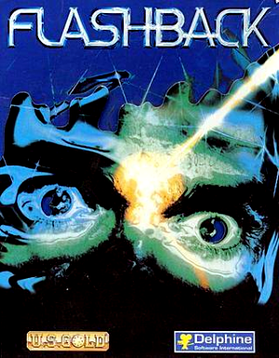
The most direct point of comparison — Bermuda Syndrome is openly modelled on Flashback’s movement system, screen structure and puzzle design. Playing both back to back makes for a fascinating study in how the same formula can be transplanted into a completely different tone and setting. Flashback is the more refined game, but Bermuda Syndrome has charms of its own that make the comparison interesting rather than simply unflattering.
Heart of Darkness (1998)
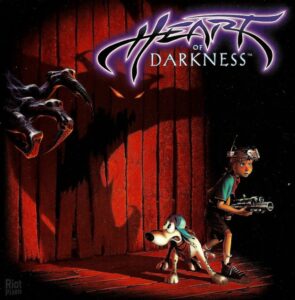
Heart of Darkness shares Bermuda Syndrome’s willingness to take the cinematic platformer into lush, visually distinctive natural environments rather than the grey corridors of sci-fi dystopia — and its hand-drawn animation has the same sense of crafted expressiveness that makes Bermuda Syndrome’s creature work so memorable. A natural next step for anyone the setting resonated with.