

Description
Impossible Mission is not the most celebrated game in this genre, and it is rarely the first name that comes up in conversations about cinematic platformers. But it should be in the conversation — because in 1984, five years before Prince of Persia and seven years before Another World, Dennis Caswell built something that had no real precedent: a fluid, cinematic action platformer with digitised speech, procedurally generated rooms, and a secret agent protagonist who somersaulted between platforms with an elegance that nobody had seen in a game before.
Developed solo by Caswell and published by Epyx, Impossible Mission puts you in the role of a secret agent infiltrating the underground complex of Professor Elvin Atombender — a mad scientist tampering with national security computers. You have six hours to search his rooms, collect password fragments, assemble them into a deactivation code, and reach the control room before time runs out. The robots will kill you. The clock will kill you. The puzzle will probably kill you. It is, in every sense, an impossible mission.
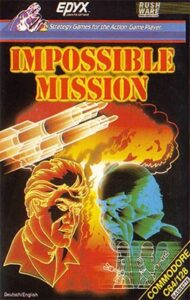
Year: 1984
Developer: Epyx · Dennis Caswell
Atmosphere: Spy Thriller · Tense · Retrofuturistic
Visual Style: Early 8-bit Animation · Fluid Rotoscoping
Focus / Pace: Action Puzzle · Fast-Paced
Platforms: Commodore 64 · Apple II · Atari 7800 · ZX Spectrum · Amstrad CPC · BBC Micro · Sega Master System
Why Impossible Mission Stands Out
In 1984, games did not do this. Characters did not move like this. The running, somersaulting animation of the agent was hand-drawn on graph paper, converted into hex strings, and typed directly into the code by Caswell — and it was unlike anything on any platform at the time.
Combined with digitised speech at a moment when nobody expected a home computer to speak, Impossible Mission was a genuine shock to anyone who encountered it. It planted seeds that Another World, Flashback, and Prince of Persia would later grow into a genre.
The Story
Professor Atombender is tampering with national security. You are the agent sent to stop him. That is everything the game tells you, and everything it needs to. The story is the setting, and the setting is the complex — fifty-plus procedurally generated rooms, each slightly different every time you play, filled with robots on patrol patterns and furniture hiding the password fragments you need. It is less a narrative and more a puzzle with atmosphere.
Graphics
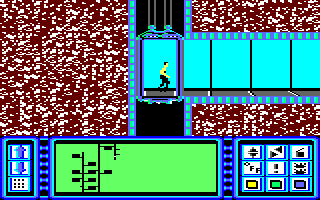
Honestly, pretty remarkable for 1984. The agent’s animation is genuinely fluid — a somersault between platforms that Caswell has said he animated before he knew how it would be used, simply because it looked good. The environments are clean and readable, and the robots move with enough variety to feel genuinely threatening rather than mechanical. The digitised speech remains startling even now — hearing a Commodore 64 address you directly in 1984 must have been, by all accounts, a jaw-dropping moment.
BUT while they are clean and readable, they still are 1984 graphics. I kinda struggle with the early 80s era (not my time), and even the animation is good, it is still a little “too old” for me to actually enjoy it.
🕵️ Did You Know?
The famous opening line — “Another visitor. Stay a while… stay forever!” — was provided by a company called Electronic Speech Systems. It was such a successful showcase of their technology that ESS dramatically raised their prices immediately after the game came out. Epyx never used them again. The line itself has become one of the most quoted in gaming history — and the name of a popular German gaming podcast, Stay Forever, is a direct tribute to it.
Gameplay
A hybrid of action platforming and puzzle solving that feels ahead of its time. You navigate rooms, search furniture for password pieces, use a pocket computer to assemble fragments, and manage a strict six-hour countdown that ticks down with every death and every tool use. The robots can be frozen temporarily — but the freeze wears off, and their patrol patterns mean every room requires reading before entering.
It is hard. Genuinely, persistently hard — in the tradition of its era, where games were designed to last weeks rather than hours. Believe me, you will need patience! But the satisfaction of assembling a password is exactly the kind of earned reward the genre has always done best.
🎮 My honest opinion
Impossible Mission is a historical document as much as it is a game — proof that the cinematic platformer instinct existed years before the genre had a name. Caswell built something genuinely ahead of its time, and the smoothness of that agent’s somersault is – objectively – pretty impressive if you consider it has been released in 1984.
Gameplay wise, it is super hard, and to be honest, i struggle a lot with everything that is pre-NES/SNES. I gave it a go, but it is not for me. However, if you have any interest in where this genre came from, Impossible Mission is essential context.
Where can I play Impossible Mission?
The original Commodore 64 version is the definitive experience and is widely available via emulation. The Sega Master System port from 1990 is also well-regarded. An official remake was released in 2007 for PlayStation Portable and Nintendo DS, though it received mixed reviews.
Games similar to Impossible Mission
Prince of Persia (1989)
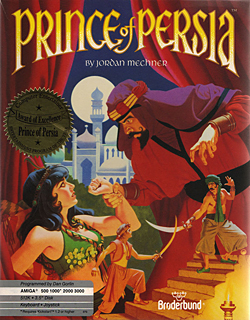
The most direct successor in spirit — another game built around fluid, rotoscoped character animation and a ticking clock, made by a solo developer who obsessed over movement the way Caswell obsessed over his agent’s somersault. Prince of Persia is the bridge between Impossible Mission and the genre as we know it today.
Another World (1991)

Another World took everything Impossible Mission gestured toward — cinematic presentation, fluid animation, a hostile world navigated by instinct — and pushed it to its logical conclusion. If Impossible Mission is the blueprint, Another World is the finished building.