Description
Four years after Prince of Persia, Jordan Mechner came back for a sequel he was genuinely conflicted about making. His own journal from the period captures the tension perfectly: he knew what everyone expected — Prince of Persia in new clothes with a few new twists — and he was not sure that was enough. He delivered it anyway. The result is a game that is harder to love than the original, more ambitious in some ways, less focused in others, and ultimately the kind of sequel that tells you exactly why the first game was special by showing you what happens when you start adding things.
Published by Brøderbund in 1993, The Shadow and the Flame picks up eleven days after the ending of Prince of Persia. Jaffar is back — somehow — and the Prince finds himself stripped of his appearance and thrown out of the palace he just saved. He escapes on a ship and spends the next seventy-five minutes trying to get back to Persia, back to the princess, and back to himself.
Year: 1993
Developer: Jordan Mechner · Brøderbund
Atmosphere: Arabian Nights · Magical · Tense
Visual Style: Rotoscoped Animation · Enhanced 16-bit
Focus / Pace: Puzzle Platforming · Deliberate
Platforms: MS-DOS · SNES · Macintosh · FM Towns · PC-98
How It Compares to Prince of Persia 1
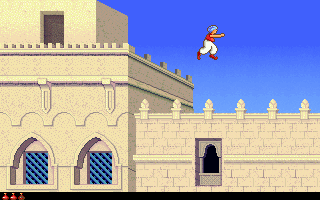
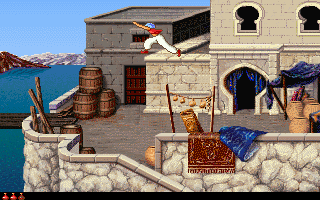
The original Prince of Persia had one setting — a Persian dungeon — and used that constraint brilliantly. Every level felt like a variation on the same tightly controlled idea. The Shadow and the Flame throws that out and takes you across the world: ship decks, desert caves, ruined temples, magical floating islands. It is more visually varied and more graphically impressive than the original, and the environments feel genuinely exotic in a way the dungeon never needed to.
But something is lost in the expansion. The original’s tension came partly from its confinement — that ticking clock and those torchlit corridors created a specific kind of pressure that the wider world of the sequel dilutes. The combat is heavier here too, with multiple guards attacking simultaneously in ways the original never attempted. More enemies, more environments, more content — and yet most people who have played both will tell you the first game is the better one. I think that is because Prince of Persia 1 knew exactly what it was. The sequel is still figuring it out.
The Story
Jaffar has returned from the dead, disguised himself as the Prince, and taken over the palace. Nobody recognises the real Prince — not even the princess. Stripped of his identity, he escapes and begins a journey through distant lands to uncover how to defeat Jaffar permanently. The story is more elaborate than the original’s simple rescue mission, with flashbacks and a more explicit mythology around the shadow and the flame of the title. It is also less elegant — the original’s simplicity was a strength, and the sequel occasionally mistakes complexity for depth.
The ending opens onto a cliffhanger involving an old witch watching the couple through a crystal ball. A third game was planned to resolve it. It was never made.
Graphics
The most immediately impressive upgrade over the original. The DOS version is noticeably more detailed than Prince of Persia 1 — richer colours, more elaborate environments, a Prince who wears actual clothes rather than a white outfit. The SNES port, released in 1996, is the most visually polished version and is generally the recommended way to play today. The animation is slightly less fluid than the original in places — a consequence of the expanded scope and the tighter production schedule — but remains far ahead of most contemporaries.
🗡️ Did You Know?
There is a moment late in The Shadow and the Flame where the Prince must die to progress — stepping into something that kills him is the only way to move forward, with absolutely no indication that this is what you are supposed to do. No hint, no visual cue, nothing.
Players who hit this section in 1993 without a hint book simply got stuck. Mechner has since acknowledged it as a design flaw. It is the kind of trap that could only exist in an era before playtesting was taken seriously.
Gameplay
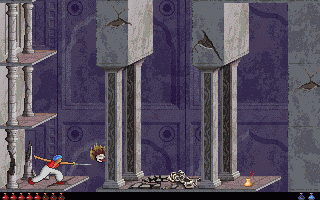
Familiar and harder. The movement system is essentially unchanged from the original — the same committed, physical platforming that made Mechner’s games distinctive — but the level design is more punishing, the combat encounters more complex, and the difficulty spikes more erratic. Unlimited lives soften the blow compared to the first game, but time lost to deaths cannot be recovered, and the seventy-five minute clock ticks regardless.
There are genuine highlights — a sequence where you run across collapsing floorboards while jumping between ledges is genuinely thrilling — and some of the new trap designs are inventive. But there are also moments of frustration that feel less designed than accidental, and the pacing of the final levels becomes genuinely gruelling.
🎮 My honest opinion
The Shadow and the Flame is a good game and a slightly disappointing sequel. It is broader than the original, harder than the original, and more visually impressive than the original — and somehow less satisfying than all three of those things suggest it should be.
The magic of the first game was in its restraint, and the sequel spends most of its runtime proving that restraint was a choice rather than a limitation.
Play the original first — obviously. Then play this one if you want more, knowing that more is both what you will get and also, subtly, the problem.
Where can I play Prince of Persia 2?
The MS-DOS original is available via GOG. The SNES version is widely regarded as the best and is playable via emulation. A mobile remake for iOS and Android was released by Ubisoft in 2013, taking significant liberties with the original level design.
Games similar to Prince of Persia 2
Prince of Persia (1989)
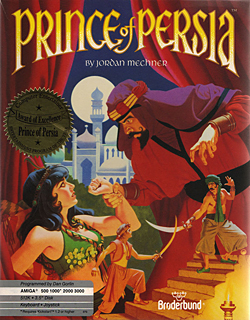
Play the original first if you have not already — not because it is a prerequisite, but because it is the better game and The Shadow and the Flame is best understood as a response to it. Everything the sequel adds and loses makes more sense when you know what it is working from.
Flashback (1992)

Flashback took the Prince of Persia formula and pushed it in a different direction — more fluid, more narrative, more sci-fi. Released the year before The Shadow and the Flame, it represents what the genre looked like when someone other than Mechner tried to build on his foundation. A fascinating comparison.