

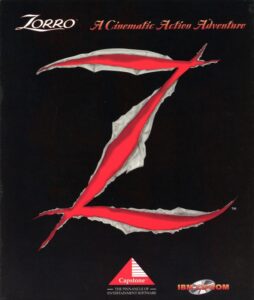
Zorro is a 1995 DOS cinematic platformer developed and published by Miami-based Capstone Software — a studio that spent much of the mid-90s acquiring licensed properties and building games around them with varying degrees of success.
This one is based on Johnston McCulley’s classic masked vigilante character, set in 19th century California where Don Diego Vega — secretly Zorro — must stop the villainous Don Cortez from stealing an ancient mission treasure. It wears its Prince of Persia influences openly, adds live-action FMV cutscenes to advance the story, and delivers a game that is more interesting as a curiosity than as an experience.
Year: 1995
Developer: Capstone Software Atmosphere: Historical · Swashbuckling · Adventure
Visual Style: Pixel Art · Animated Sprites
Focus / Pace: Action Platforming · Deliberate
Platforms: MS-DOS
The Game
Zorro plays in the Prince of Persia mould — deliberate side-scrolling movement, careful jumping across gaps, climbing ledges, and navigating traps across a series of environments that range from desert wilderness to ghost ships to hacienda interiors. What gives it a slightly different flavour from a straight clone is the dual weapon system: Zorro carries both a whip and a sword, and switching between them adds a layer of tactical consideration that pure PoP imitators rarely attempt. The sword hits harder in close quarters; the whip gives you reach to deal with enemies at a safer distance. It is a simple distinction but it works, and it gives combat just enough personality to feel like it belongs to this character specifically rather than any generic swordsman.
The live-action FMV cutscenes are the other notable addition — a very 1995 choice that has not aged gracefully but gives the game a certain campy charm in retrospect. Actors in costume deliver the story beats between levels with the kind of earnest over-seriousness that only mid-90s licensed games managed to achieve. They are not good, exactly, but they are entertaining in a way that pure pixel art exposition never quite manages.
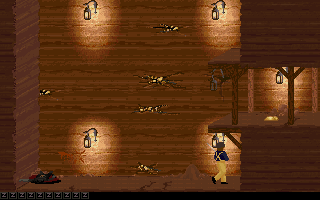
The environments are more visually varied than Cruel World’s relentless dungeon grey — desert canyons, a ghost ship, mission courtyards — which gives the game a sense of adventure that suits the Zorro character better than a grim dungeon crawler ever could. The level design is uneven, with some sections feeling genuinely well-constructed and others frustratingly arbitrary, and the controls require the same period of adjustment that the genre traditionally demands.
Critically it landed poorly — Next Generation magazine gave it one star out of five, writing that they “strongly recommend you avoid this title like the plague” — which feels harsh in retrospect, though not entirely unwarranted. Zorro is not a good game by any rigorous standard. But it is a more interesting one than its reputation suggests, and for fans of the genre’s licensed oddities it has a certain scrappy appeal.
🎮 My honest verdict
Zorro sits a meaningful step above Cruel World in the Prince of Persia clone hierarchy — the dual weapon system, the varied environments, and the sheer personality of the Zorro setting give it a flavour that the more anonymous dungeon crawlers lack. It is still a flawed, uneven game that never fully delivers on its premise, and the FMV sequences will either charm or horrify depending on your tolerance for mid-90s cheese.
But as a piece of genre history — a licensed cinematic platformer built around one of popular fiction’s most enduring swashbuckling heroes — it earns its place in this database. Available through abandonware archives via DOSBox.
Games similar to Zorro
Prince of Persia (1989)
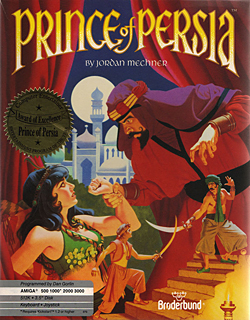
The template Zorro borrows from so heavily — and the game that does everything Zorro attempts with considerably more craft and elegance. If the deliberate movement and trap-heavy level design of Zorro appealed, Prince of Persia is the essential next step.
Blackthorne (1994)
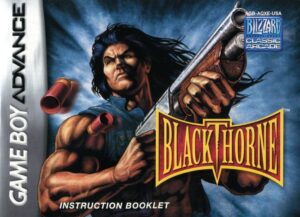
Blackthorne shares Zorro’s combination of cinematic platforming and more action-oriented combat, built around a similarly charismatic lone protagonist navigating a hostile world with a specific toolkit. More polished and more mechanically interesting than Zorro, it represents the better version of what Capstone was reaching for.