
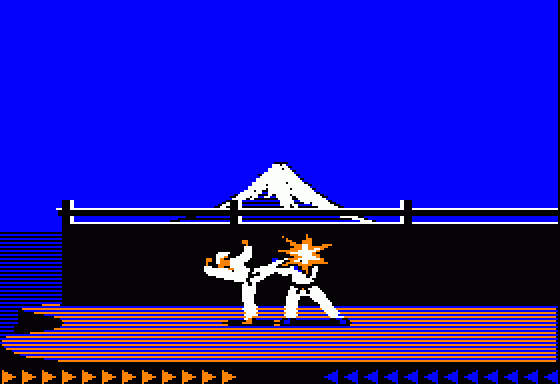
Description
Jordan Mechner is the creator of Prince of Persia — one of the most influential games ever made. But before that, he was a seventeen-year-old Yale student sitting in the film society, watching Kurosawa movies between classes, and obsessing over how cinema told stories. Then he sat down at his Apple II and tried to put all of that into a video game. In 1984. On a computer with 48 kilobytes of memory.
What came out was Karateka — and one of the most direct ancestors of everything on this site.
Published by Brøderbund in 1984, Karateka follows an unnamed hero ascending a mountain fortress to rescue Princess Mariko from the warlord Akuma. Screen by screen, enemy by enemy, you fight your way upward. It is simple, deliberate, and for 1984, almost impossibly cinematic.
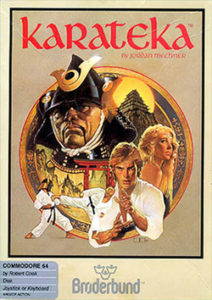
Year: 1984
Developer: Jordan Mechner · Brøderbund
Atmosphere: Martial Arts · Dramatic · Cinematic
Visual Style: Rotoscoped Animation · Early 8-bit
Focus / Pace: Action Platforming · Deliberate
Platforms: Apple II · Commodore 64 · Atari 8-bit · Atari 7800 · Atari ST · NES · ZX Spectrum · Amstrad CPC · MS-DOS
Why Karateka Stands Out
Mechner pioneered rotoscoping in video games with Karateka — filming his karate teacher performing punches and kicks, and his own father running and climbing onto the hood of a car, then tracing the footage frame by frame into the game pixel by pixel. The result was character movement nobody had seen in a game before: fluid, naturalistic, weighted.
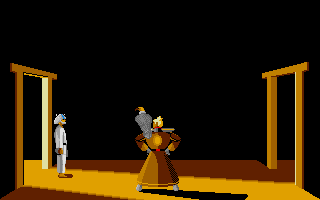
Combined with cinematic techniques borrowed directly from film — cross-cutting between the hero’s approach and the warlord preparing his response, a scrolling camera that felt genuinely directed — Karateka was a game that looked and felt like a movie in a way that simply did not exist before it.
The Story
A hero. A princess. A warlord. A mountain fortress. Karateka does not complicate things — and it does not need to. The story exists to give the fighting meaning, and the brief cutscenes between screens — Mariko watching anxiously, Akuma issuing orders — give the whole thing a dramatic stakes that contemporary games almost never attempted. For 1984, this was storytelling.
Graphics and Sound
Revolutionary for their time. The rotoscoped animation gives the characters a physical presence that sprite-based games of the era simply could not match, and the environments — cliff faces, stone courtyards, the shadowed interior of the fortress — are composed with a care that reflects Mechner’s film background.
The score, composed by his father Francis Mechner, drew from Wagner’s Ring Cycle and is remarkably dramatic for something running on an Apple II.
🎬 Did You Know?
When Karateka came out in 1984, a teenage John Romero — who would go on to co-create Doom — was so blown away by it that he wrote Jordan Mechner a fan letter. That letter ended up in Digital Eclipse’s 2023 interactive documentary The Making of Karateka, alongside Mechner’s design documents, journals, and early prototypes. The documentary is genuinely worth your time if you want to understand where this genre came from.
Gameplay
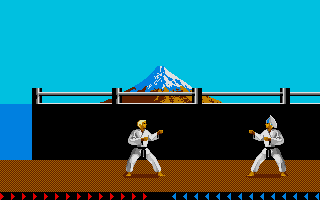
Combat-focused and deliberately paced. You approach each screen, enemies appear, you fight — blocking, punching, kicking — with a fluidity that feels ahead of its time. The game is not long, and by modern standards it is not complex. But the commitment to making every fight feel like a film sequence rather than a mechanical exchange gives it a quality that most contemporaries lacked completely.
The famous instant-death trap — approach the final room running rather than walking and Mariko immediately kills you herself, mistaking you for an enemy — is one of the great troll moves in game history, and one that people are still talking about forty years later.
🎮 My honest opinion
Karateka is a historical document as much as it is a game, and I think that is the honest way to approach it in 2026.
It is short, it is simple by modern standards, and the combat has aged less gracefully than the animation. But the influence is impossible to overstate — without Karateka there is no Prince of Persia, without Prince of Persia there is no Another World, and without Another World there is none of this.
Play it for what it is: the first time anyone tried to make a game feel like a film, and largely succeeded.
Where can I play Karateka?
The original Apple II, Commodore 64, and Atari versions are widely available via emulation. A 2012 remake for Xbox 360, PlayStation 3, Windows, and iOS updated the visuals and added new gameplay elements with mixed results.
Most highly recommended is Digital Eclipse’s The Making of Karateka (2023), available on Steam, PlayStation, Xbox, and Switch — an interactive documentary that includes multiple playable versions of the game alongside Mechner’s journals, design documents, and video interviews. It is one of the best ways to experience any classic game ever made.
Games similar to Karateka
Prince of Persia (1989)
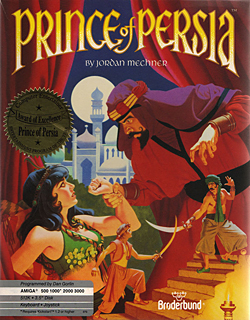
Mechner’s own follow-up — five years later, technically more ambitious, mechanically richer, and the game that took everything Karateka started and pushed it to its natural conclusion. The rotoscoping is more fluid, the world is more complex, and the platforming finally matches the cinematic ambition. Essential.
Impossible Mission (1984)
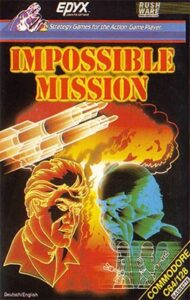
Released the same year by a different solo developer with the same obsession — fluid animation, cinematic presentation, a single protagonist against a hostile world. The two games together represent the moment the genre was invented, and they make a fascinating pair.