

Cinematic platformers feel so distinct that it is easy to imagine the genre appearing fully formed with Prince of Persia in 1989. One game, one moment, one revolution. But the truth is messier — and considerably more interesting.
Long before the term existed, developers across the 1980s were independently experimenting with realistic movement, cinematic presentation, vulnerable protagonists, and hostile worlds that felt designed rather than abstract. None of them were trying to invent a genre. Most of them had never heard of each other. They were just following their instincts about what games could be — and those instincts, scattered across a decade of home computer experimentation, converged into something that Prince of Persia would later crystallise into a recognisable form.
This is the story of the games that made that possible. Most of them are forgotten. All of them matter.
What makes a Cinematic Platformer?
If you want the full definition, our complete guide to the genre covers it in detail. The short version: a cinematic platformer is a side-scrolling game built around realistic movement, atmospheric world-building, and cinematic presentation — where the story is told by what you see rather than what you are told, and where death has consequence and meaning. Prince of Persia is the founding text. Everything in this article led to it.
Before the genre existed: The ingredients were already there
Here is the thing about genre origins: they are almost never what they look like in retrospect.
We tell the story of the cinematic platformer as if Jordan Mechner sat down in 1986 with a clear vision and built Prince of Persia from nothing. But that is not how creative work happens. Mechner was playing games obsessively, watching films obsessively, keeping journals obsessively — absorbing influences and synthesising them into something new. The same was true of Éric Chahi, who built Another World two years later by drawing on a completely different set of references and arriving at something that shared Prince of Persia’s philosophy without copying its design.
What they were both responding to — without knowing it was a genre in formation — was a set of ingredients that had been appearing independently across the early 1980s home computer scene:
- Realistic animation — characters that moved like people rather than sprites, with weight and momentum and consequence.
- Puzzle traversal — environments designed to be read and navigated rather than run through, where observation mattered as much as reflexes.
- Environmental tension — worlds that felt hostile and authored, where the space itself was the antagonist.
- Cinematic framing — presentation that borrowed from film language: wide shots, dramatic reveals, pacing through silence and staging.
- Vulnerable movement — protagonists who could die from a fall, who committed to their jumps, who felt physically present in the world.
None of these ideas existed in one game before Prince of Persia. They were scattered across half a decade of experiments by developers who were trying to make games feel like something more than abstract systems. This article traces where each ingredient came from — and how they eventually found each other.
Karateka (1984): The birth of cinematic movement
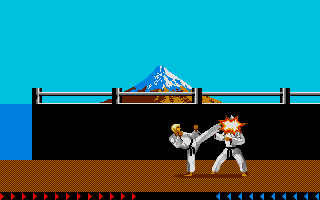
Jordan Mechner was seventeen years old when he started making Karateka. He was enrolled at Yale, watching Kurosawa films between classes, and obsessing over how cinema told stories through image and movement rather than dialogue and exposition. Then he sat down at his Apple II and tried to put that obsession into a game.
The result was not a cinematic platformer. Karateka is a fighting game — a side-scrolling series of one-on-one martial arts encounters that takes you from the entrance of a mountain fortress to its throne room, where a warlord holds a princess captive. There is no platforming, no environmental puzzle solving, no atmospheric world to navigate in the genre’s sense.
But Karateka invented something that the genre would later depend on completely: the idea that a video game character could move like a person.
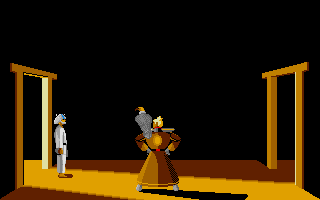
To animate Karateka, Mechner filmed his karate teacher performing punches and kicks, and his own father running and jumping — then traced the footage frame by frame onto graph paper and converted it to pixels by hand. The result was character movement of a fluidity and naturalism that nothing else on an Apple II in 1984 came close to matching. When the karateka walked, you felt the weight. When he fought, you felt the commitment. When he died, he fell in a way that registered as physical rather than mechanical.
That is the Karateka inheritance. Not the genre’s puzzles, not its atmosphere, not its worldbuilding — but its fundamental conviction that movement should feel real. Every cinematic platformer ever made has been chasing that same conviction, whether its developers knew they were or not.
Lode Runner and The Castles of Doctor Creep: Puzzle spaces and trap design
In 1986, Jordan Mechner sat down and wrote what he called the one-sentence idea for Prince of Persia: “a game that combined the ingenuity of The Castles of Doctor Creep with the smooth animation of Karateka.”
That sentence is one of the most useful things ever said about the genre’s origins — because it identifies, with perfect clarity, the two separate problems that Prince of Persia solved simultaneously. Karateka gave him the movement. The Castles of Doctor Creep gave him the puzzles.
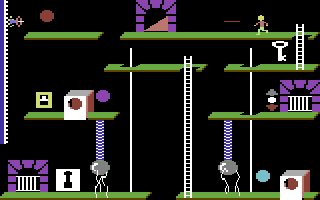
Castles of Doctor Creep was a 1984 Commodore 64 game by Ed Hobbs — obscure enough that it almost certainly never reached most of the people reading this — built around Rube Goldberg-style environmental puzzles: hit one switch and that opens a gate but closes another, use the timing of moving platforms to thread yourself through a sequence of obstacles, die and come back and try to read the environment more carefully. The puzzles were the world. The world was the puzzles.
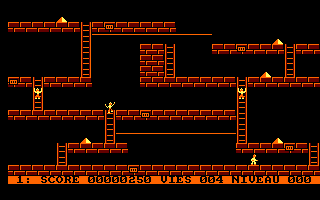
Lode Runner, which Mechner also cited explicitly, contributed something adjacent — the instinct for authored environmental challenges rather than generated or abstract ones. In Lode Runner you were not reacting to enemies in a generic space; you were reading a specific, designed situation and figuring out the one path through it. That instinct — that the environment is a puzzle to be solved through observation rather than reflexes — runs through every cinematic platformer ever made.
Neither game had the movement. Neither had the atmosphere. But together they had the design philosophy that Mechner would later wrap in rotoscoped animation and call Prince of Persia.
Dragon’s Lair and the dream of interactive cinema
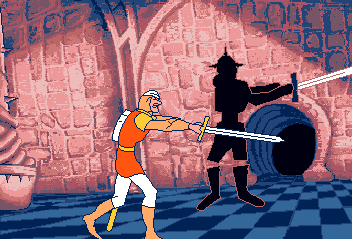
In August 1989, Éric Chahi was working at Delphine Software when he saw something that changed everything. The Amiga adaptation of Dragon’s Lair had just been released — the first home computer version of the laserdisc arcade game — and for the first time someone had stored the original animations on floppy disks and run them on home hardware.
Chahi watched the characters fill the visual space like a cartoon, moving with a size and expressiveness no other home computer game approached. And then he had a thought that would directly produce Another World: those animations were drawn in flat colour. I could do that with vector outlines.
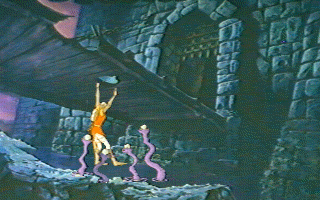
Dragon’s Lair had sacrificed interactivity almost entirely in pursuit of visual spectacle — closer to a cartoon than a game, and criticised for it at the time. But what it demonstrated — what lodged in Chahi’s mind and refused to leave — was that games could look like films. That the visual gap between cinema and gaming could be narrowed.
Dragon’s Lair is not a cinematic platformer. It is barely a game in the conventional sense. But it planted a seed in the mind of the person who would build Another World — and that makes it one of the most consequential things in the genre’s history.
Impossible Mission (1984): Vulnerability and Isolation
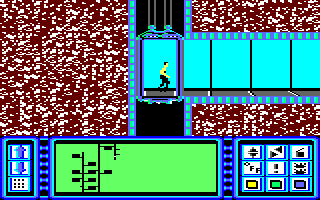
Of all the games in this article, Impossible Mission is the one I find most fascinating — because it did not just influence the cinematic platformer from the outside. It actually built several of the genre’s most distinctive elements from scratch, a full five years before Prince of Persia, without anyone at the time having the vocabulary to describe what it was doing.
Developed by Dennis Caswell and published by Epyx in 1984, Impossible Mission puts you in the role of a secret agent infiltrating the underground complex of a scientist tampering with national security systems. You have six hours. You navigate rooms by running, jumping, and searching furniture for password fragments. The robots will kill you. The clock will kill you. And every death costs you time you cannot get back.

Éric Chahi cited Impossible Mission directly as one of the games he was thinking about when he built Another World — specifically its movement between “Karateka and Impossible Mission” as the mechanical range he was aiming for. That citation is worth dwelling on. What Chahi saw in Impossible Mission was something specific: a game where the protagonist felt genuinely isolated and vulnerable in a hostile designed environment, where the world was dangerous and reading it carefully was the only survival strategy.
The somersaulting animation of the agent — which Caswell drew on graph paper before he knew how it would be used, simply because it looked good — was as fluid as anything Mechner was doing with Karateka, and it achieved something similar: a protagonist who felt physically present rather than abstractly represented. The specific tension of moving through Elvin Atombender’s complex — reading patrol patterns, timing freezes, searching furniture while the clock ticked — is recognisably the same tension that Prince of Persia and Another World would later perfect.
Impossible Mission is not quite a cinematic platformer. But of everything in this article, it comes the closest to being one before the genre existed.
Weird Dreams, Dark Castle, and the strange proto-cinematic platformers
My favourite section to write — because these are the games that nobody planned. While Mechner was consciously constructing the cinematic platformer out of documented influences, a handful of other developers were stumbling onto the same territory entirely by accident, following instincts about what games could feel like without knowing anyone else was doing the same thing.
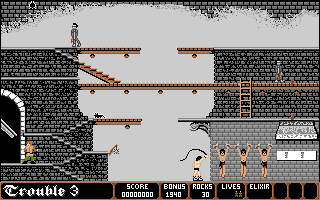
Dark Castle (1986) is the most direct example. A Macintosh game by Silicon Beach Software with flip screens, trial-and-error gameplay, fall damage, multiple death animations, and hub screens connecting its areas — it reads like a cinematic platformer checklist assembled by someone who had never heard the term. The Black Knight’s haunted castle has genuine atmosphere: not the polished, intentional atmosphere of Prince of Persia, but the raw, slightly chaotic atmosphere of a game whose creators were reaching for something they could not quite name.

Weird Dreams (1988) is stranger and more interesting. A British game set inside a man’s subconscious — levels include feeding a wasp cotton candy and being attacked by a baked chicken — with large anatomically detailed characters, gruesome death animations, and a design built entirely around set-piece situations where observation matters more than reflexes. It is close to Another World — not because anyone copied anyone, but because both were independently reaching toward the idea that a game could be a sequence of designed situations rather than a continuous mechanical challenge.
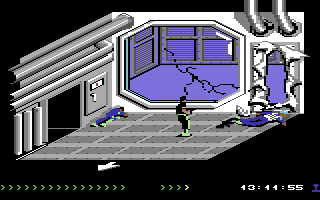
Project Firestart (1989) is the most remarkable of the three — a C64 sci-fi horror game inspired by Alien with cinematic cutscenes, minimalistic UI, a survivor to escort, and a real-time clock. It was doing things survival horror would not systemise for another decade. On a C64 in 1989. That is almost incomprehensible.
None of these games were trying to invent anything. The fact that their instincts converged on something recognisably similar to what Mechner and Chahi were building is not coincidence. It is evidence that the genre was trying to exist before anyone knew what to call it.
Prince of Persia (1989): The moment the genre became whole
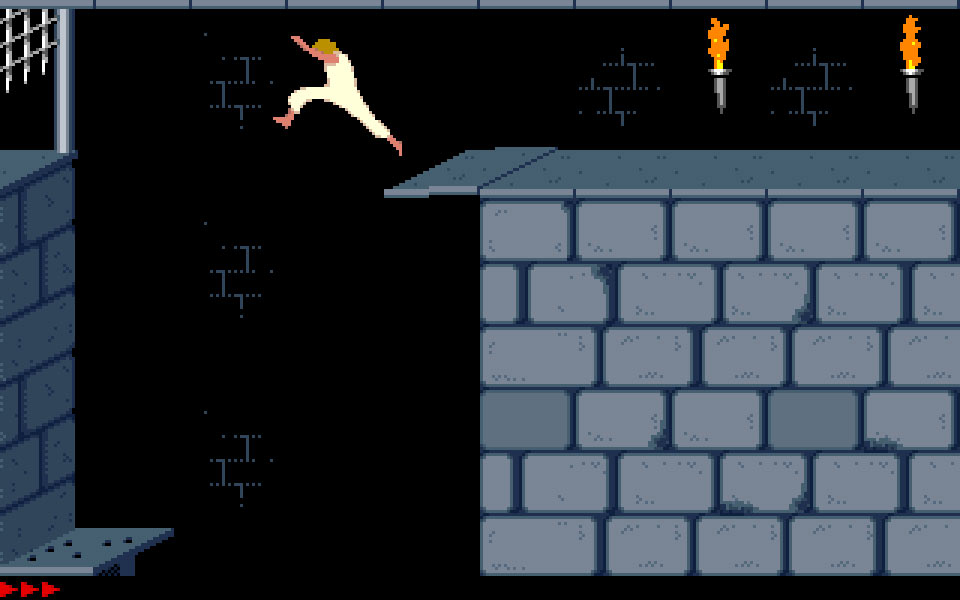
Everything in this article so far has been fragments. Karateka gave movement. Castles of Doctor Creep gave puzzle design. Dragon’s Lair gave visual ambition. Impossible Mission gave vulnerability and isolation. Each of these games had one or two of the ingredients. None of them had all of them.
Prince of Persia had all of them.
When Jordan Mechner released his game on October 3rd 1989, he had spent three years filming his brother in a school parking lot, tracing Errol Flynn sword fights from VHS tapes frame by frame, and writing obsessively about what he was trying to build. What he finally released unified everything that had been scattered across the decade — cinematic movement, puzzle traversal, vulnerability, film language, environmental storytelling — into a coherent design philosophy that had never existed before.
The dungeon felt like a place, not a level. The sword combat required reading your opponent rather than mashing inputs. The one-hour time limit transformed every second into something with genuine stakes. The protagonist moved with consequence — he committed to his jumps, paid for his mistakes, and died in ways that felt physical rather than mechanical.
Before Prince of Persia, all of these elements existed. After it, they existed together.
They were assembled into a coherent design philosophy that would inspire Another World two years later, Flashback the year after that, and an entire lineage of games that continues to this day. The genre did not begin here exactly. But it cohered here. And that is everything.
Another World (1991): The genre finds its soul

Prince of Persia created the template. Another World did something different — it asked what the template was actually for.
Éric Chahi was twenty-three years old and working in his parents’ house in France when he built it, almost entirely alone, on an Amiga 500 with 1MB of RAM. He had Prince of Persia on his shelf. He had Impossible Mission and Dragon’s Lair in his memory. He had Star Wars and Frank Frazetta and Dragon Ball. And from all of that he built something that shared Prince of Persia’s physical commitment and deliberate movement — and then stripped away everything else that reminded you it was a game.
No HUD. No score. No dialogue. No explanation. Just a physicist on an alien planet with no idea how he got there and no one to ask.
What Another World added was atmosphere as a primary design value — not as decoration, but as the point. The loneliness is the game. The wordless relationship between Lester and his alien companion, built entirely through shared danger and small gestures of trust, is the game. Chahi was not trying to make a challenging platformer with cinematic presentation. He was trying to make you feel like you were somewhere.
That shift is where the modern lineage of the genre truly begins. Every game on this site that prioritises atmosphere over mechanics, that tells its story through environment rather than exposition — Limbo, Inside, Little Nightmares — traces its DNA back here. They all found their way back to the same instinct that Chahi had in his parents’ house in France in 1989: that a game could make you forget you were playing one.
Prince of Persia made the cinematic platformer possible. Another World made it matter.
The legacy of the precursors
Genres do not appear from nowhere. They emerge from accumulated experiments — from developers following instincts they cannot fully articulate, building on things they have played and watched and absorbed without always knowing why.
The cinematic platformer emerged from a decade of exactly this. Dennis Caswell drew a somersault on graph paper because it looked good. Ed Hobbs built puzzles out of switches and gates because he found them ingenious. The creators of Dragon’s Lair filled the screen with cartoon characters because they wanted games to look like films. Jordan Mechner filmed his brother in a parking lot because he wanted movement to feel real. Éric Chahi saw those Amiga animations and thought: I could do that with polygons.
None of them were inventing a genre. They were following curiosity
It was about a movement, about atmosphere, about what games could feel like if you took them seriously as experiences rather than just systems. And those separate curiosities, pursued independently across half a decade of home computer experimentation, converged into something that nobody had planned and everyone could recognise when they finally saw it.
That is how genres actually work. Not with a single inventor and a founding moment, but with scattered ideas that slowly find each other — until one day a game comes along that unifies them so completely that everything before it looks, in retrospect, like preparation.
The games in this article are that preparation and they deserved to be named!
FAQ
Prince of Persia (1989) is widely considered the first — the game that unified realistic movement, puzzle traversal, cinematic framing, and environmental storytelling into a coherent design philosophy. Karateka and Impossible Mission are the most significant precursors, but neither fully qualifies
Not quite. Karateka invented the cinematic movement philosophy the genre would later build on — rotoscoped animation, physical commitment, a protagonist who felt present rather than abstract. But it is a fighting game without the environmental puzzle solving and atmospheric world-building that define the genre. The most important ancestor rather than the first example.
Mechner’s most direct influences were Karateka, The Castles of Doctor Creep (puzzle design), and Lode Runner (authored environmental challenges). Film influences included Raiders of the Lost Ark and The Adventures of Robin Hood — Mechner traced Errol Flynn’s sword fight from the latter frame by frame for the combat animation.
No — but it transformed them. Prince of Persia established the template in 1989. Another World took that template and made atmosphere the primary design value rather than a quality of the presentation. It is where the modern lineage truly begins.
Chahi cited the Amiga adaptation of Dragon’s Lair as the spark for Another World’s polygon approach, Impossible Mission as a movement reference, and Prince of Persia as a direct design influence. Film influences included Star Wars and the art of Frank Frazetta.
Games that anticipated the genre before Prince of Persia crystallised it. The clearest examples are Karateka, Impossible Mission, The Castles of Doctor Creep, and Dragon’s Lair. Weird Dreams and Dark Castle arrived at similar ideas independently, through different routes, at roughly the same moment.