
Description
I think the opening minutes of Neva are some of the most affecting in any cinematic platformer I have played. A woman in a red cloak. Two wolves. A wave of inky black corruption sweeping through a forest. And then one wolf is gone, and there is only a cub left, nuzzling at what remains. Before a word has been spoken — before a single mechanic has been explained — I already felt something. That is a very specific kind of craft, and Nomada Studio have it.
Developed by Barcelona-based Nomada Studio and published by Devolver Digital, Neva is the follow-up to Gris — one of the most visually celebrated indie games of 2018. Where Gris was a solitary journey through grief, Neva is about something messier and more complicated: the relationship between a parent and a child, and how it changes as the child grows. You play as Alba, the woman in the red cloak. Neva is her wolf cub. And the journey you take together — through spring, summer, winter, and back to spring — is structured around that relationship evolving in real time.

Year: 2024
Developer: Nomada Studio
Atmosphere: Emotional · Dreamlike · Dark Fantasy
Visual Style: Painterly Animation · Stylized 2.5D
Focus / Pace: Exploration Action · Narrative-Driven
Platforms: PlayStation 4 · PlayStation 5 · Xbox Series X/S · Windows · Nintendo Switch
Why Neva stands out
Most action platformers put the growth arc on the player character. Neva deliberately inverts that. Alba does not get new powers or abilities as the game progresses. Neva does. She starts as a helpless cub you have to shield and protect, and gradually becomes a fierce, antlered force of nature who fights alongside you — and eventually leads the way. I find that structural decision genuinely moving, and I think it is the smartest thing the game does.
Neva made our personal top ten — one of the most emotionally affecting cinematic platformers of recent memory. See where it sits in our best cinematic platformers of all time.
The Story
The world is decaying. Dark corruption is spreading through forests and landscapes that were once beautiful, and Alba and Neva are making their way toward its source. The story is told almost entirely without dialogue — the only words spoken are Alba calling Neva’s name in different intonations — and it unfolds through what you see: the changing seasons, the growing threat, the way Neva responds to the world around her differently as she gets older.
I think the seasonal structure is one of the best storytelling decisions in recent memory. Spring feels open and gentle. Summer introduces danger gradually. Winter is where things get genuinely bleak, and the final act hit me harder than I expected. The story is not subtle — it is very much about love and loss and the fear of losing something you are responsible for — but it earns its emotional weight because the relationship between Alba and Neva is built so carefully across the whole runtime.
My one honest observation is that some of the middle chapters lose a little momentum before the winter section recovers everything. The emotional stakes can dip slightly when the game leans too heavily on combat at the expense of the quieter moments that make the relationship feel real.
Graphics
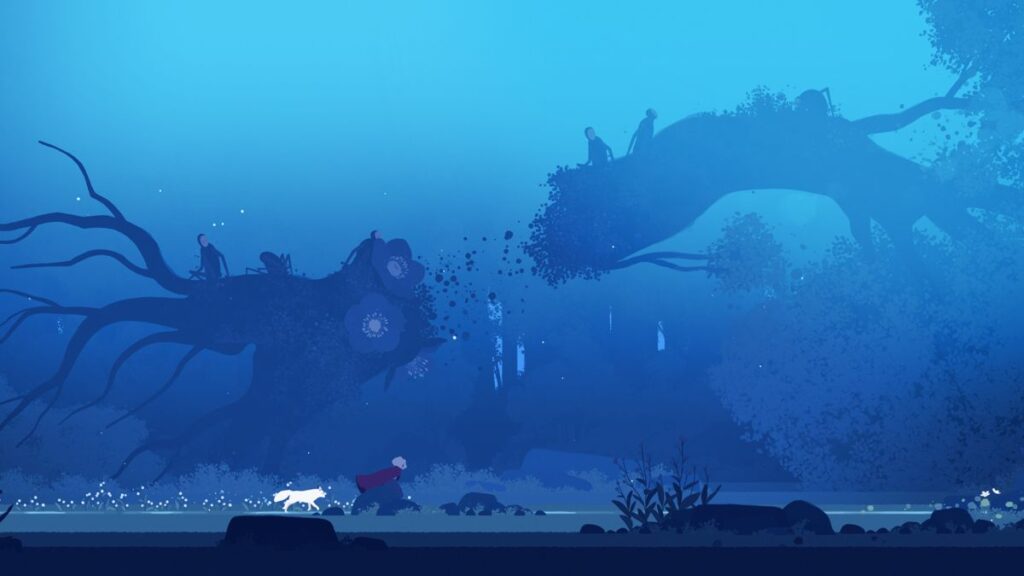
Nomada Studio’s watercolour painterly style was already exceptional in Gris, and Neva takes it to another level — richer, more detailed, more kinetic. The environments shift with the seasons in ways that feel genuinely distinct: lush spring greens, hazy summer forests, the stark whites and blues of winter, the unsettling beauty of corruption spreading through otherwise gorgeous landscapes.
Neva herself is one of the most beautifully animated characters I have seen in this genre. Watching her grow across the seasons — from a trembling, clumsy cub to a majestic creature with antlers and real presence — is achieved entirely through visual design and animation, with no cutscene explanations needed. Every frame of this game could function as a standalone illustration. I noticed myself stopping to look around more often than any game in recent memory.
🤖 Did You Know?
Several members of Nomada Studio — including co-founders Roger Mendoza and Conrad Roset — became parents themselves during the development of Neva. The game’s central theme of parenthood, and the specific emotional texture of watching something you love grow from helplessness into independence, came directly from those lived experiences.
Princess Mononoke served as a key visual inspiration for the game’s design — and the story originally revolved around two human characters before the team fell in love with early drafts of Neva the wolf and rebuilt the whole narrative around her.
Gameplay
Unlike Gris, Neva has a proper combat system — and I think it is mostly a success. Alba’s moveset is elegant: a three-hit combo, a dash, and the ability to call Neva into the fight as she grows older and more capable. The combat is not mechanically deep, but it is fluid and visually spectacular, and the gradually expanding toolkit — particularly when you gain the ability to command Neva directly — keeps things interesting across the four to five hour runtime.
The platforming is lighter and more intuitive than in Gris — less puzzle-focused, more about momentum and movement. There are environmental puzzles, including a lovely section using reflective ice surfaces in the winter chapter, but they are used sparingly and never overstay their welcome.
Where I think the game is slightly less successful is in making Neva feel like a genuine companion rather than a mechanic. In the early chapters, when she is small and needs guiding, she feels alive — getting distracted by butterflies, whining at the edge of gaps, cowering in combat. By the time she is fully grown, she can feel more like an ability than a character. I noticed this most in a section where you are briefly separated from her, and the loss registers as losing an attack rather than losing a friend. That is a small but real gap between what the game is trying to do and what it actually achieves mechanically.
Atmosphere
The score by Berlinist is one of the best I have heard in any game this year. Haunting, orchestral, and perfectly calibrated to the emotional temperature of each chapter — it intensifies the highs, deepens the lows, and in the winter section delivers something that I found genuinely difficult to sit through without feeling it physically. Combined with the watercolour visuals and the almost total absence of dialogue, the atmosphere Neva creates is consistently immersive and frequently overwhelming in the best possible way.
There is also a pet button. You can stop at any point and give Neva a pat. I used it far more than I am willing to admi
🎮 My honest opinion on Neva
Neva is not a perfect game — the combat has a ceiling it hits too quickly, and the mid-game loses some of the emotional precision of the opening and closing chapters. But I think it is a genuinely remarkable piece of work, and the relationship at its centre is something I have not quite experienced in this genre before.
What stays with me most is the structural honesty of it: the fact that it is Neva who grows, not Alba, means you spend the whole game in the position of a parent — protective at first, then gradually stepping back, then watching something you love become something that does not need you in the same way anymore. That is a genuinely difficult thing to make a player feel through a game mechanic. Nomada Studio pulls it off more often than not.
I recommend it without hesitation.
Where can I play Neva?
Neva is available on PC DRM-free on GOG , and at a discount on Fanatical. You can play it on PlayStation 4, PlayStation 5, Xbox Series X/S, and Nintendo Switch. A standalone prequel expansion titled Prologue is set to release in February 2026, designed for players who have already completed the main game. The base game is modestly priced and completable in a single focused evening or two relaxed sessions.
Games similar to Neva
Gris (2018)

Gris is the obvious starting point — Nomada Studio’s previous game, equally beautiful, equally wordless, and equally committed to carrying emotional weight entirely through art direction and music. If Neva moved you, Gris is essential. I would argue Gris has a slightly more coherent emotional arc, but the two games belong together.
Planet of Lana (2023)
Planet of Lana shares Neva’s central dynamic of a young woman and a animal companion navigating a world that is actively falling apart around them. The tone is lighter and the gameplay more puzzle-focused, but the emotional core — the bond between two beings who cannot speak to each other but clearly understand each other — is recognisably the same.
If you are drawn to cinematic platformers that foreground a relationship rather than a protagonist — games where the emotional stakes come from who you are with rather than what you are doing — A Tale of Paper, Never Alone, and Hoa all share that same gentle, affecting sensibility.