
Description
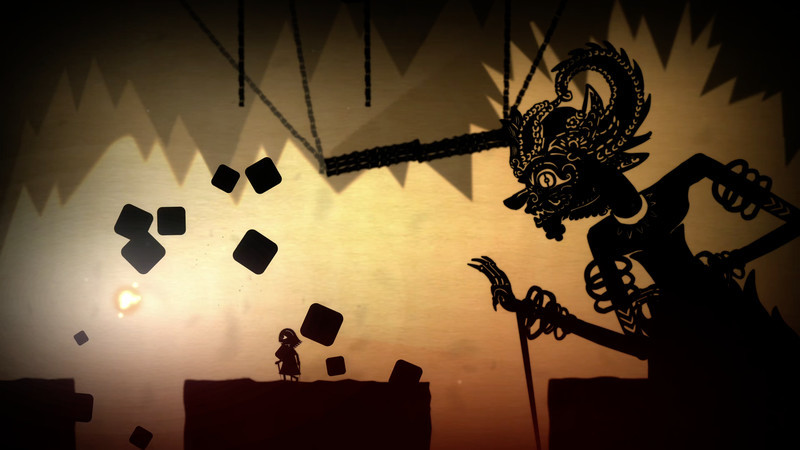
Projection: First Light is one of those games that stops you in your tracks the moment you see it. Not because it looks like anything else you’ve played — but because it genuinely doesn’t. The entire world is built like a shadow puppet theatre: characters glide across the screen on little sticks, backdrops assemble themselves as you move through them, and everything is cast in black silhouette against warm, layered backgrounds. My first reaction, honestly, was just: where did this come from? It feels like someone preserved a lost art form inside a video game, and somehow made it work as a platformer too.
Developed by Australian studio Shadowplay Studios with co-developer Sweaty Chair Studio and published by Blowfish Studios, Projection: First Light grew out of a game jam experiment and eventually became something genuinely special — a puzzle platformer built around light, shadow, and a quiet tour through the history of shadow puppetry across five distinct cultures. It is not a perfect game, and I’ll get into the frustrations honestly. But it is absolutely a game worth knowing about.

Year: 2020
Developer: Shadowplay Studios · Sweaty Chair Studio
Atmosphere: Mythological · Dreamlike · Theatrical
Visual Style: Shadow Puppetry · Silhouette Art
Focus / Pace: Puzzle Platforming · Relaxed
Platforms: PlayStation 4 · PlayStation 5 · Xbox One · Xbox Series X/S · Windows · Nintendo Switch · iOS
Why Projection: First Light stands out
The central idea is so simple and so good that I’m still a little surprised no one did it first. In a world made entirely of shadow, shadow is solid. So if you control the light, you control the platforms. The game hands you a floating ball of light alongside your protagonist Greta, and from that point on, everything you build to progress — every ramp, every platform, every wall — is a shadow you cast yourself.
It is an idea that makes complete thematic and mechanical sense, and it gives the game an identity that no amount of pretty pixel art could replicate — see why it earned a place among the most inventive cinematic platformers ever made and see where it features in our complete best of guide.
The Story
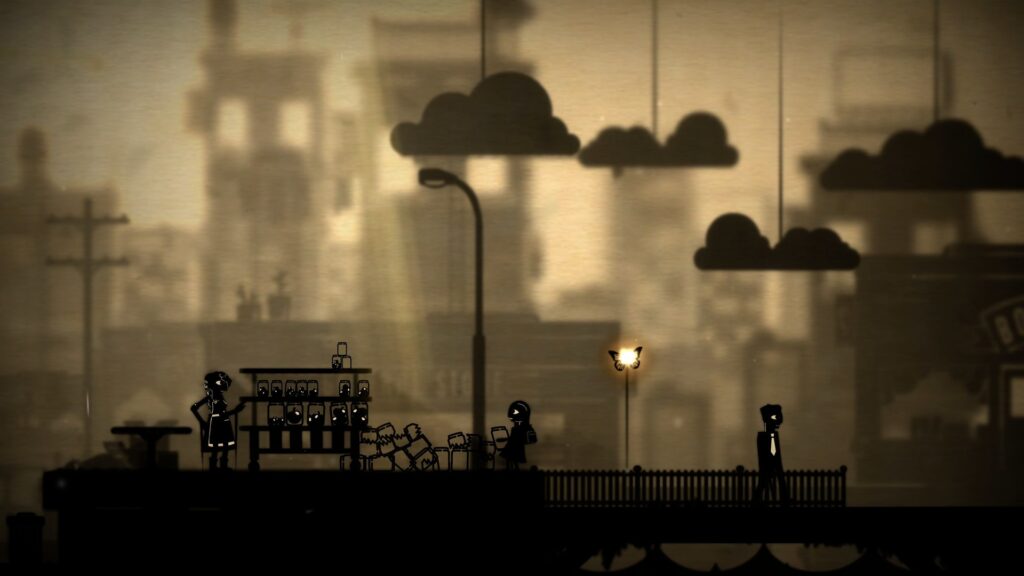
Greta lives in a shadow puppet world — literally a world that looks like a shadow puppet show — and one day she spots a luminous butterfly fluttering through her town. She chases it, causes a minor trail of chaos in the process (crashing a car, knocking over a shopkeeper’s wares), gets grounded by her parents, and then escapes through a hidden door at the top of her room. From there, her journey takes her across Indonesia, China, Turkey, Greece, and 19th century England, where she encounters legendary heroes from each culture along the way.
None of this is told through dialogue. Everything is communicated through gesture, expression, and brief image-filled speech bubbles. The story is simple — it is really just a coming-of-age adventure about a curious girl seeing the world — and it works on exactly those terms. I found myself genuinely charmed by Greta. She has a lightness to her that carries the whole thing. The cultural encounters with the local heroes feel a little thin, if I’m being honest — they are sympathetic but somewhat flat — but the cumulative effect of moving through five richly distinct worlds gives the journey a real sense of scope and progression.
Graphics
This is where Projection: First Light genuinely earns its place. The art direction is unlike anything else in the genre — everything on screen is treated like a real shadow puppet performance. Characters are held up on visible sticks. Set pieces are assembled around you in real time as you move through levels. The backgrounds layer depth through overlapping silhouettes in a way that feels genuinely handcrafted rather than digital.
What really impresses me is how much each cultural world feels different despite using the same fundamental silhouette vocabulary. Indonesia is warm and earthy, with organic shapes and the sounds of wooden percussion. China feels more intricate and architectural, with elaborate dragon statues and lantern-lit stages. Turkey and Greece bring geometric patterns and mythological grandeur. 19th century England shifts everything into the mechanical, with gears and cogs and Victorian industrial shapes. The team did real research here — they consulted actual shadow puppeteer and historian Richard Bradshaw — and it shows in every frame.
🏆 Did You Know?
The idea for Projection: First Light was born at a game jam, when designer Michael Chu started toying with light manipulation as a mechanics experiment. It was only when a colleague saw the prototype and suggested using shadow puppets that the visual concept clicked into place.
From there, Shadowplay Studios consulted real Australian shadow puppeteer and historian Richard Bradshaw, who guided the team on the order of cultural worlds and helped ensure every representation was accurate and respectful. The soundtrack was then recorded using period-authentic instruments from each culture — whistles, lutes, and wooden percussion — to match the world Greta is exploring.
Gameplay
The core loop is built around one mechanic: position your light source to cast a shadow from an object in the environment, and use that shadow as a physical platform for Greta to walk, jump, or climb on. Shadows behave realistically — the angle and distance of your light determines the direction and length of the shadow — and the game slowly layers new complications on top of this foundation. Lanterns you can light to create secondary shadows. Air-blowing blocks. Moving obstacles. Time-sensitive sequences. Boss encounters. By the mid-game, the puzzle design genuinely opens up and there are moments where you feel like a genius for figuring out a solution.
Here’s where I need to be honest though: the light mechanic is fussy. Sometimes moving the butterfly too quickly causes the shadow to pass through an object rather than land on it. There are moments where you position the light perfectly, the shadow looks exactly right, and Greta still slides off because the physics decided to disagree. Most of the time this isn’t a disaster because the checkpoint system is very generous — but it happens enough that I had to put the game down a few times just to cool off. The frustration is real. The good news is that when it works, and it works most of the time, it is genuinely satisfying.
The controls also split your attention between Greta on the left stick and the light on the right stick, which requires a bit of mental rewiring at first. It becomes second nature fairly quickly, but the occasional imprecision of the light control — especially during timed sequences — makes those sections harder than they probably needed to be.

Pacing
Projection: First Light has over 60 levels spread across its five cultural chapters, and that is honestly a little more than it needed. The first chapter in Indonesia moves slowly, essentially functioning as an extended tutorial that introduces the shadow mechanics without much complexity. The game really finds its rhythm in China and beyond, where the puzzles grow more layered and the environments become more visually striking.
My honest feeling is that trimming it down by maybe 20% would have made it a tighter experience. There are stretches in the middle chapters where you can feel the design spinning its wheels a little before introducing the next interesting idea. That said, the pacing between cultural chapters works well — each new world brings a fresh aesthetic and a new mechanic or two, which keeps the forward momentum going even when individual levels drag.
At around five to six hours for a single playthrough, it never becomes a slog. And if you want to collect all the hidden butterflies scattered through each level, there is a good reason to revisit.
Atmosphere
This is where the game really lands for me. There is something genuinely magical about watching a world that is openly, theatrically artificial — you can see the sticks holding the characters up, you can watch the backdrops pop into place — and still feeling completely immersed in it. Projection: First Light commits to the puppet theatre conceit so fully that it stops being a stylistic choice and starts feeling like the only way this world could possibly exist.
The soundtrack is a huge part of that. Each cultural chapter has its own score performed with instruments appropriate to the region — whistles and wooden percussion for Indonesia, stringed instruments for China, something more ceremonial for Greece and Turkey. It is atmospheric without being distracting, and it shifts register beautifully as the tone of each chapter changes. The only thing I’d flag is that the sound effect for the butterfly companion — a constant fairy-tinkle as you move the light — can become slightly grating over a long session. Worth turning the effects down a notch in the settings.
🎮 My honest opinion on Projection: First Light
I came away from Projection: First Light genuinely glad it exists. The central mechanic is one of those ideas that feels so natural in retrospect that you wonder why it took until 2020 for someone to do it properly. The art direction is stunning, the cultural research gives it a depth and sincerity that most platformers never bother with, and Greta is a completely charming protagonist to spend time with.
The frustrations are real. The shadow physics can be inconsistent in a way that feels unfair rather than challenging, and the game is a little longer than it perhaps needs to be. But none of that changes the fact that there is nothing quite like it — not in this genre, not in indie games more broadly. If you have any affection for atmospheric puzzle platformers, for shadow puppetry as an art form, or just for games that try something genuinely new and mostly pull it off, Projection: First Light deserves your attention.
The cultural research behind Projection: First Light is part of what makes it genuinely special — we wrote about it alongside the other games that took that same approach in our feature on cinematic platformers built on real cultural tradition.
Where can I play Projection: First Light?
Projection: First Light is available on PC via Steam and on PlayStation 4, PlayStation 5, Xbox One, Xbox Series X/S, and Nintendo Switch through their respective digital stores. It was originally released as an Apple Arcade exclusive before making its way to all major platforms in September 2020.
Games similar to Projection: First Light
If the shadow puppetry aesthetic, wordless storytelling, and puzzle-driven exploration of Projection resonated with you, these two are well worth your time.
Never Alone (Kisima Ingitchuna) (2014)
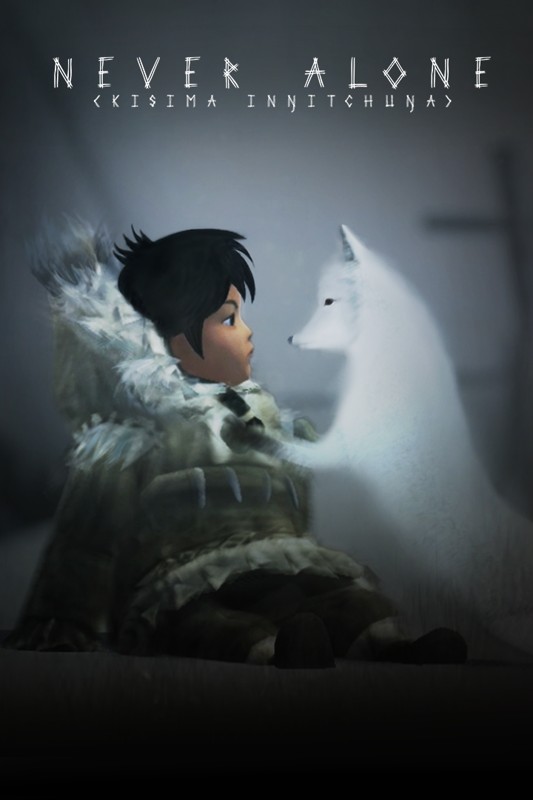
Never Alone shares Projection’s genuine interest in cultural storytelling as more than decoration. Built in collaboration with Alaska Native storytellers, it uses its cinematic platforming as a framework for exploring real folklore and tradition — the same respectful, research-led approach that makes Projection feel so distinct from games that simply borrow an aesthetic without understanding it.
A Juggler’s Tale (2021)

A Juggler’s Tale shares Projection’s theatrical soul more than almost any other game in the genre. Like Projection, it presents its world as a literal performance — a puppet show narrated in real time, with a string-controlled protagonist navigating a dark fairytale world. The two games feel like they belong on the same shelf, built by people who genuinely love what puppetry can express that other art forms can’t.
If you are drawn to games that treat visual art forms — shadow puppetry, folklore illustration, hand-crafted aesthetics — as the foundation of everything rather than just a coat of paint, titles like Hoa, Gris, and The Mooseman all share that same sensibility in different ways.